12 Week FITT Plan: Sarcopenia Prevention Exercises for People Over 50
A FITT based 12 week plan of resistance and aerobic exercises for people over 50, with protein timing tips and when to book a DEXA scan.

The most effective way to prevent or slow sarcopenia is a progressive resistance program combined with regular aerobic and balance training, following a structured frequency, intensity, time, and type (FITT) plan. Aim for resistance training multiple times a week, aerobic activity several times per week, and sessions running between about 20 and 60 minutes depending on your goals. Track progress with simple screening tools like gait speed and grip strength, and add a DEXA scan when you need an objective measurement of muscle mass.
TL;DR:
- Resistance training combined with aerobic and balance exercises yields the greatest functional improvements, with optimal weekly volume around 20 minutes for strength and 70 minutes for walking ability.
- Progression should focus on increasing load before volume, spreading sessions across the week, and reassessing intensity every 2 to 4 weeks to avoid injury and maintain gains.
- Functional tests like gait speed, sit-to-stand, and grip strength should be retested every 6 to 8 weeks to monitor progress, with DEXA scans used for precise body composition assessment when needed.
- Daily movement and breaking up sitting time are crucial complements, as prolonged sedentary periods undermine strength and muscle maintenance, even with regular exercise.
- A 12-week structured program should include clear phases of adaptation, building, and consolidation, with small goals and social support improving adherence.
Table of Contents
- What the Evidence Shows About Resistance and Multicomponent Training
- How to Structure Frequency, Intensity, Time, and Progression
- A Practical Exercise Library You Can Start This Week
- Adapting Your Routine for Arthritis, Osteoporosis, and Heart Conditions
- Protein, Timing, and Vitamin D for Muscle Maintenance
- Tracking Your Progress: Functional Tests and When to Get a DEXA Scan
- Why Objective Body-Composition Tracking Fills a Real Gap
- Your 12-Week Starter Plan for Building Real Strength
- Why Stretching and Mobility Work Still Matter
- Getting Warm-Ups and Cool-Downs Right at This Stage of Life
- Why Cutting Sedentary Time Matters Just as Much as Working Out
- What to Actually Expect if You Start This Program
- Use The platform to Set a Real Baseline for Your Progress
- Sources
- FAQ
What the Evidence Shows About Resistance and Multicomponent Training
Resistance training is the single most effective exercise intervention for sarcopenia. That conclusion shows up again and again across systematic reviews and network meta-analyses covering thousands of older adults, and it’s the closest thing to a settled question in this field. But resistance work alone isn’t the ceiling. When you combine it with aerobic conditioning and balance drills, the functional gains, walking speed, grip strength, and daily mobility, outperform any single-mode program.
A 2025 network meta-analysis pooling 35 randomized controlled trials and 2,331 participants found that multicomponent exercise paired with adequate protein intake produced significantly greater improvements in handgrip strength, gait speed, and skeletal muscle mass than exercise alone or nutrition alone. That’s a meaningful finding because it settles a debate that’s dogged this field for years: whether lifting weights matters more than eating enough protein. The answer is that they work together, not in competition, and neither one alone gets you the same result.
Here’s where it gets genuinely useful for anyone trying to build a realistic weekly routine. Dose-response research now gives us actual numbers instead of vague advice to “exercise more.”
Statistic Callout: Pooled analyses suggest that maximal gains in muscle strength are associated with roughly 1,043 cumulative minutes of resistance training, while improvements in walking ability require substantially more, around 2,716 cumulative minutes. Spread across a year, that strength threshold works out to about 20 minutes a week, though the research emphasizes distributing that volume across multiple sessions rather than cramming it into one long workout.
That second number is worth sitting with. Walking ability, arguably the outcome that matters most for staying independent, takes nearly triple the training exposure that strength does. If you’ve been doing resistance work for two months and wondering why your gait hasn’t visibly changed while your grip strength has, this is why. Strength adaptations show up faster than functional walking gains, and expecting them on the same timeline sets you up for disappointment.
A separate systematic review and network meta-analysis of exercise interventions for sarcopenia reinforces the same hierarchy: resistance training and multicomponent programs consistently improve functional outcomes in older adults who already show signs of muscle loss or sit at high risk for it. This isn’t a fringe finding from one lab. It’s the consensus across an entire body of research spanning multiple countries and study designs.
Clinical guidelines have caught up to the evidence. The Singapore clinical practice guidelines for sarcopenia explicitly recommend progressive resistance training and multicomponent activity as first line prevention strategies, paired with protein intake of at least 1.0 grams per kilogram of body weight daily. That guideline framing matters because it moves resistance training out of the “nice to have” category and into the category of a recommended medical intervention, the same tier as blood pressure medication or cholesterol management.
What none of this evidence supports is the old assumption that aerobic exercise alone, walking or cycling without any loading, does enough to protect muscle mass as you age. Cardio keeps your heart and lungs strong. It doesn’t recruit the fast-twitch muscle fibers that resistance training does, and those fibers are precisely the ones sarcopenia targets first. If your current routine is a daily walk and nothing else, you’re covering one base and leaving the other wide open.
How to Structure Frequency, Intensity, Time, and Progression
FITT isn’t a fitness industry buzzword. It’s a practical framework, frequency, intensity, time, and type, that turns “exercise more” into a plan you can actually follow and adjust. Here’s how each piece breaks down for sarcopenia prevention specifically.
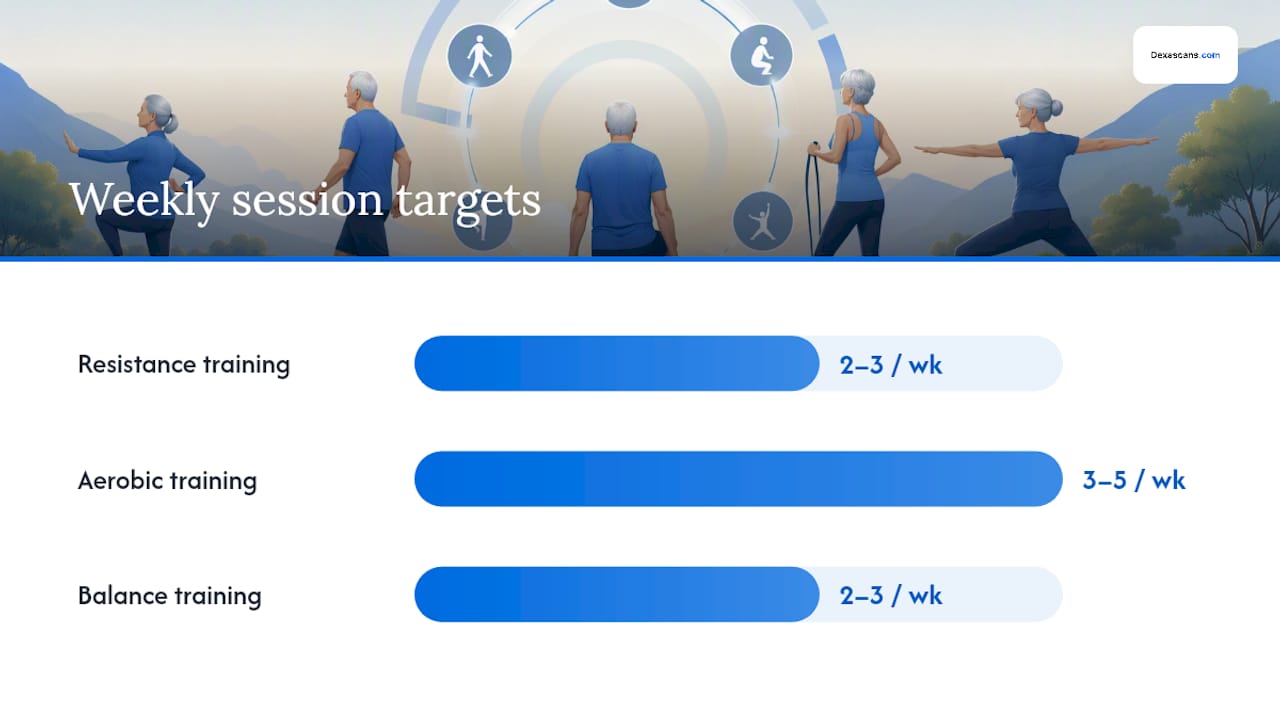
As your body adapts over several weeks, progress toward 60% to 80% of your one-rep max for continued strength gains. A systematic review of resistance training prescriptions found effective intensity ranges spanning 20% to 85% of one-rep max across different populations, but for most older adults starting out, the moderate end is both safer and just as effective for building the initial adaptation. Two to three sessions per week is the typical target, with at least one rest day between sessions working the same muscle groups.
Aerobic frequency and intensity. Three to five sessions a week, each running 30 to 50 minutes, at a moderate intensity of roughly 50% to 70% of your maximum heart rate, or a perceived effort around 12 to 14. Walking, swimming, and stationary cycling all qualify, and you don’t need all five sessions to look identical. Two moderate walks and one longer bike ride cover the target just fine.
Balance training frequency. Two to three sessions a week, either folded into your resistance or aerobic days or done as standalone 5 to 20 minute blocks. Balance work is the piece most people skip, and it’s often the piece that prevents the fall that actually triggers a downward spiral in independence.
Progression rules that actually matter:
- Increase load before you increase volume. Add weight or resistance first; only add more sets or sessions once the current load feels manageable for two consecutive weeks.
- Prioritize spreading your weekly volume across more sessions rather than fewer, longer ones. Research on training frequency shows that going from two to three sessions a week allows for higher total weekly volume with less per-session fatigue, which matters enormously for adherence when you’ve got joint sensitivity or limited recovery capacity.
- Reassess your intensity every 2 to 4 weeks. If an exercise that used to feel like a 13 on the effort scale now feels like an 8 or 9, it’s time to progress.
- Never jump straight to high-intensity single sessions above 80% of your one-rep max early in a program. That’s where injury risk climbs fastest, particularly for anyone returning to exercise after months or years of inactivity.
Pro Tip: Keep a simple log of total minutes trained each week rather than obsessing over which specific exercise you did. Total training exposure, tracked in cumulative minutes, correlates more closely with strength and function gains than any single workout’s details.
One more piece worth flagging: frequency isn’t really about hitting a magic number of workouts. It’s a tool for managing fatigue while still accumulating enough total volume to trigger adaptation. If three sessions a week feels unsustainable right now, two well-structured sessions with slightly higher per-session volume still work. The threshold that matters is your weekly total, not the specific day count.
A Practical Exercise Library You Can Start This Week
You don’t need a gym membership or a rack of dumbbells to start. Bodyweight, a sturdy chair, and a resistance band cover almost everything on this list.
Lower-body strength moves:
- Sit-to-stand progressions. Start by using your arms to push off a chair seat. As you get stronger, cross your arms over your chest and stand using leg strength alone. Once that’s easy, slow the descent to a 3 to 4 second count, then progress to a lower, softer chair.
- Step-ups. Use a stair or a sturdy step 6 to 8 inches high. Step up leading with one leg, then alternate. Add hand weights once ten reps per leg feels easy.
- Partial squats. Hold onto a counter or sturdy chair back, bend your knees to a comfortable range, roughly a quarter to a third of full depth, and stand back up. Deepen the range gradually as hip and knee mobility improve.
- Calf raises. Hold a counter for balance, rise onto your toes, and lower slowly. Progress to single-leg calf raises once double-leg raises feel effortless for 15 reps.
Upper-body strength moves:
- Standing or anchored rows. Loop a resistance band around a doorknob or sturdy anchor at chest height, pull the band toward your ribs, squeezing your shoulder blades together.
- Wall or counter push-ups. Hands on a wall or counter edge, feet back, lower your chest toward the surface and push back. Progress from wall to counter to eventually a sturdy table as strength improves.
- Band or light-weight overhead press. Standing on a resistance band, press handles overhead, or use light dumbbells (2 to 5 pounds to start) for the same movement.
Power and speed moves (low load, controlled velocity):
- Heel-rise power lifts. Rise onto your toes with a quicker, more explosive tempo than a standard calf raise, then lower slowly. Power training, moving the concentric phase faster while keeping the load light, specifically targets fast-twitch fibers that resistance training alone can miss.
- Quick sit-to-stand transitions. Once regular sit-to-stands feel controlled, practice standing up slightly faster while keeping form clean. This builds the rate of force production you rely on to catch yourself if you trip.
Balance and mobility drills:
- Tandem stance. Stand with one foot directly in front of the other, heel to toe, near a wall or counter for safety. Hold for 10 to 30 seconds per side.
- Single-leg support. Hold onto a counter, lift one foot slightly off the floor, and balance. Progress to letting go of the counter briefly once stable.
- Dynamic stepping and obstacle negotiation. Practice stepping over a low object, like a rolled towel, or walking a marked line heel to toe. This translates directly to real-world fall prevention.
For equipment, resistance bands offer the most versatile and affordable option, since they provide continuous tension through a range of motion that free weights don’t. Ankle weights work well for leg-focused moves like step-ups. If you belong to a gym, seated leg press and cable row machines offer more joint stability than free weights while you’re building initial strength.
Adapting Your Routine for Arthritis, Osteoporosis, and Heart Conditions
Before starting any new resistance program, a quick medical check-in makes sense if you have an existing heart condition, uncontrolled high blood pressure, a recent fracture, or joint replacement within the last year. Most healthy older adults don’t need formal clearance to start walking or light resistance work, but anyone managing a chronic condition should mention new exercise plans to their physician, particularly if intensity is increasing.
Modifications differ meaningfully by condition:
- Arthritis: Reduce range of motion on painful joints rather than eliminating the movement entirely, and favor slower tempos with lighter loads over fast, heavy reps.
- Osteoporosis: Avoid spinal flexion movements, like toe-touches or sit-ups that round the back, since compression forces on a fragile spine raise fracture risk. Weight-bearing and resistance moves remain safe and beneficial, and the impact-loading component even supports bone density.
- Cardiovascular disease: Avoid breath-holding during lifts (a maneuver called the Valsalva effect), keep intensity moderate rather than pushing to exhaustion, and extend warm-up time to allow heart rate to rise gradually.
- Frailty or recent hospitalization: Start with chair-based or seated versions of every exercise on the library above, and prioritize consistency over intensity for the first several weeks.
Red flags that mean stop immediately and seek medical attention: chest pain or pressure, sudden shortness of breath disproportionate to effort, dizziness or lightheadedness, irregular heartbeat, or sudden joint pain that’s sharp rather than a dull, familiar ache. None of these are “push through it” situations.
If joint stiffness or limited range of motion is the main barrier to starting resistance work, addressing mobility first often makes the strength exercises far more comfortable to perform. Resources on improving range of motion can help identify which joints need attention before you load them.
Protein, Timing, and Vitamin D for Muscle Maintenance
Exercise builds the stimulus for muscle growth. Protein supplies the raw material. Skip one and the other underperforms.
Target at least 1.0 gram of protein per kilogram of body weight daily, the threshold clinical guidelines set for sarcopenia prevention. For a 150-pound adult, that’s about 68 grams a day, roughly the protein in three palm-sized servings of chicken, fish, or legumes spread across meals.
Statistic Callout: The dose-response research behind multicomponent programs found that pairing resistance training with adequate protein intake produced significantly greater gains in muscle mass and strength than either intervention alone, based on 35 trials and 2,331 participants. Neither piece works as well without the other.
Distribution matters as much as the daily total. Rather than saving most of your protein for dinner, a common pattern in Western eating habits, spread it across three to four meals so each one contains 20 to 30 grams. Muscle protein synthesis responds best to that even spacing. Eating a meal or snack containing protein within roughly 1 to 2 hours after a resistance session helps capture the window when muscle tissue is primed to use those amino acids for repair.
Calorie adequacy deserves equal attention. Unintentional weight loss, even a modest 5% drop over six months, often signals inadequate calorie intake and accelerates muscle loss rather than preventing it. If you’ve noticed clothes fitting looser without trying to lose weight, that’s worth mentioning to a doctor rather than treating it as a win.
Vitamin D supports muscle function, but supplementation only makes sense if a blood test confirms you’re deficient. Routine high-dose supplementation without a documented deficiency hasn’t shown the same consistent benefit, so testing before supplementing is the more sensible approach than guessing.
Tracking Your Progress: Functional Tests and When to Get a DEXA Scan
You don’t need expensive equipment to know whether your program is working. Three tests give you a reliable snapshot:
- Gait speed. Time yourself walking a marked 4 meters at your normal pace. Retest every 4 to 8 weeks; a consistent increase signals real functional improvement.
- Five-times sit-to-stand. Time how long it takes to stand up and sit down five times in a row without using your arms. Faster times over successive months indicate improving lower-body power.
- Handgrip strength. If you have access to a hand dynamometer, measure grip strength monthly. It’s a widely used proxy for overall muscle strength.
Functional tests often improve before muscle mass measurably changes, so don’t be discouraged if grip strength lags behind how much easier stairs feel.
A DEXA scan becomes useful in two specific situations: when you want an objective baseline before starting a program because your starting point is unclear, or after 3 to 6 months of consistent training to detect whether lean mass has actually increased. DEXA is considered the gold standard for measuring body composition and can detect small shifts in lean mass that scale weight or how your clothes fit simply can’t reveal. A small change on a follow-up scan, a pound or two of lean mass, is clinically meaningful even if it doesn’t feel dramatic day to day. Combining a scan with your functional test results gives a more complete picture than either measurement alone.
Why Objective Body-Composition Tracking Fills a Real Gap
Functional tests tell you how your body performs. They don’t always tell you what’s actually changing underneath, muscle versus fat versus water weight, especially if your weight on a bathroom scale barely moves during a training program. That’s the gap DEXA fills.
DEXA scanning is particularly valuable when the clinical picture is ambiguous, such as suspected sarcopenic obesity, where someone carries enough body fat that low muscle mass gets masked on a standard scale reading. It’s not a requirement for routine monitoring if your functional tests show clear, steady improvement. But for anyone who wants a genuine baseline before starting a 12-week program, or a clean before-and-after comparison after several months of consistent training, it’s the most precise tool available.
The platform lists more than 511 verified DEXA locations across 48 states, letting you compare cash pricing and book directly without a physician referral. That pricing transparency matters, since DEXA scans through hospital imaging departments often carry markups that a standalone verified location doesn’t. The precision itself is well documented: DEXA measures body fat and lean mass within roughly ±1% to 2% accuracy, precise enough to catch the kind of modest lean-mass gains a 12-week resistance program typically produces.
Use a scan the way you’d use any lab test: as one data point that complements your gait speed and sit-to-stand numbers, not a replacement for either the exercise itself or a conversation with your physician about any red-flag symptoms.
Your 12-Week Starter Plan for Building Real Strength
Progress in three phases: adaptation, build, and consolidation. Each phase runs four weeks.
- Weeks 1 to 4 (adaptation). Resistance training twice a week at moderate intensity (RPE 11 to 12), focusing on form over load. Aerobic activity three times a week, 20 to 30 minutes at a comfortable pace. Balance drills folded into two sessions a week, 5 minutes each. Total weekly training time: roughly 90 to 120 minutes.
- Weeks 5 to 8 (build). Increase resistance sessions to three times a week, nudging intensity toward RPE 13 to 14. Extend aerobic sessions to 30 to 40 minutes, still three to four times weekly. Add a third balance session and extend each to 10 minutes. Total weekly training time: roughly 150 to 180 minutes.
- Weeks 9 to 12 (consolidation). Maintain three resistance sessions but increase load or add a light power-focused move like the heel-rise power lift. Aerobic work moves to four to five sessions at 30 to 50 minutes. Balance work stays at three sessions, 15 to 20 minutes. Total weekly training time: roughly 200 to 250 minutes, approaching the cumulative volume associated with meaningful strength gains.
Adherence tactics that actually move the needle:
- Schedule sessions like appointments, same days and times each week, rather than leaving them to “whenever I feel like it.”
- Track total weekly minutes in a simple notebook or phone note rather than counting individual workouts.
- Train with a friend, spouse, or in a group class. Social accountability consistently outperforms solo willpower for older adults sticking with new routines.
- Set small, near-term goals, like completing all planned sessions this week, rather than fixating on a distant outcome like “look how I did in six months.”
Pro Tip: If you skip a scheduled session, resist the urge to double up the next day to “catch up.” Two moderate sessions most weeks beat one grueling session followed by three days of soreness that derails the rest of your week.
Muscle soreness in the first two weeks is normal and typically fades as your body adapts. Plateaus after week 6 or 7 usually mean it’s time to increase resistance rather than add more sessions, since load, not volume, is the primary driver of continued strength gains once your base level of fitness is established.
Why Stretching and Mobility Work Still Matter
Resistance training builds the muscle. Flexibility and mobility work make sure that muscle can actually move through the range you need for daily life, reaching a top shelf, turning to check a blind spot, getting in and out of a car.
Sarcopenia doesn’t just shrink muscle tissue. It often coincides with stiffening connective tissue and reduced joint range of motion, which compounds the functional decline. A hip that’s lost 15 degrees of flexion makes the sit-to-stand movement harder regardless of how strong your quadriceps are, because you’re fighting your own joint mechanics on top of the strength demand.
Dynamic stretching, moving a joint through its range in a controlled way, like leg swings or arm circles, works best before resistance or aerobic sessions. Static stretching, holding a position for 20 to 30 seconds, fits better after training when muscles are warm and pliable. Neither replaces resistance training for preventing muscle loss, but both reduce the injury risk that can sideline you from the resistance work that actually builds strength.
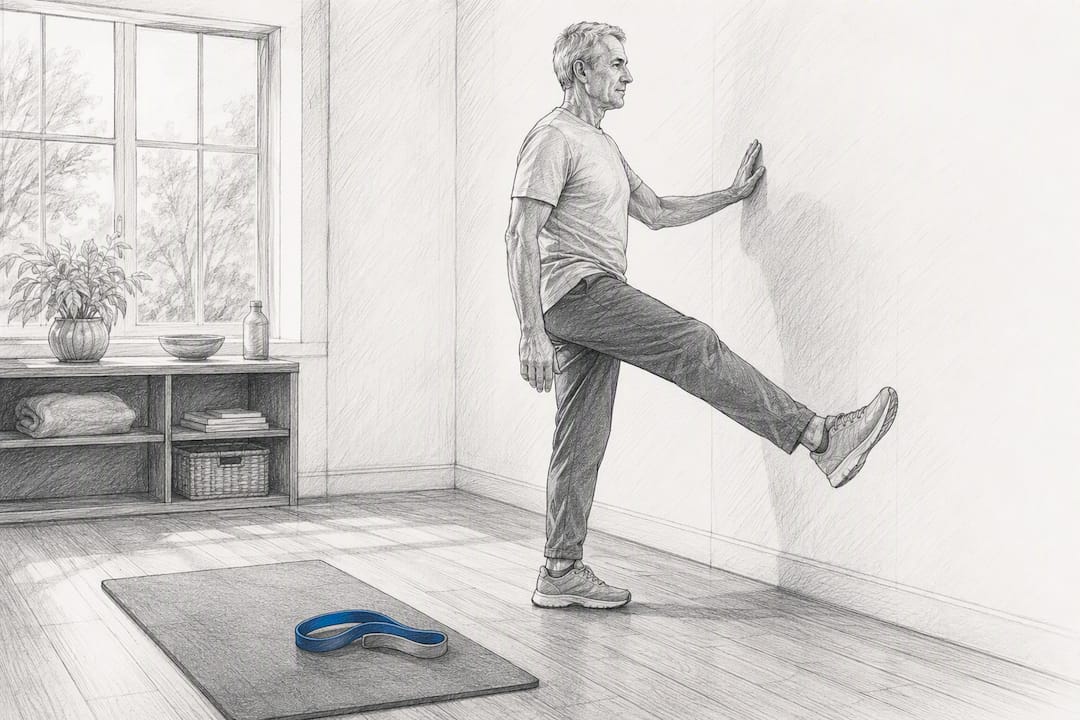
Aim for mobility work on the days you’re not doing intense resistance training, or tack 5 to 10 minutes onto the end of every session. Hip flexor stretches, shoulder rotations, and ankle circles cover the joints that most affect daily function and stability.
Getting Warm-Ups and Cool-Downs Right at This Stage of Life
Skipping the warm-up is one of the most common ways older adults get hurt starting a new exercise program, and it’s also one of the easiest fixes.
A proper warm-up for adults over 50 needs more time than it did at 25, typically 8 to 10 minutes rather than a quick 3 minutes. Start with slow marching in place or gentle arm swings to raise your heart rate and blood flow to working muscles, then move into dynamic versions of the movements you’re about to perform, bodyweight squats before a loaded squat, arm circles before an overhead press.
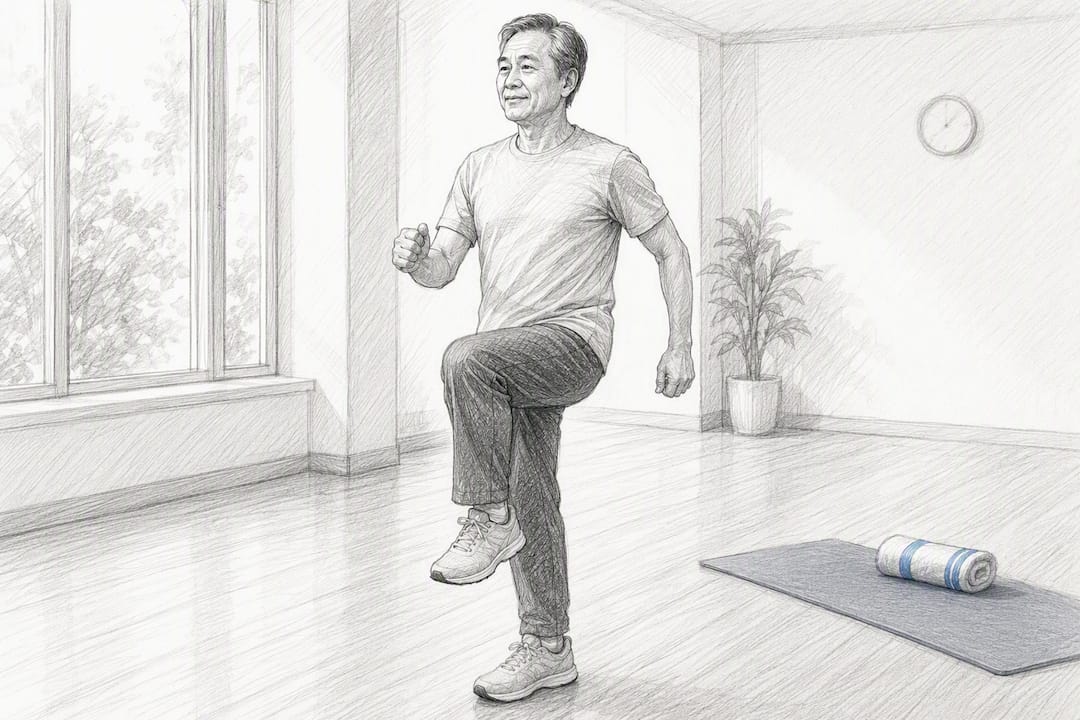
Cool-downs matter just as much and get skipped just as often. Five to ten minutes of slow walking followed by gentle static stretching helps blood pressure normalize gradually rather than dropping suddenly, which reduces dizziness risk, a real concern for anyone on blood pressure medication. Stretch the muscles you just worked while they’re still warm; hamstrings and calves after lower-body work, shoulders and chest after upper-body pressing.
Skipping these bookends to save 10 minutes is a false economy. The injury or the dizzy spell that results costs you far more training time than the warm-up ever would have.
Why Cutting Sedentary Time Matters Just as Much as Working Out
A structured exercise routine three to five times a week doesn’t cancel out ten hours of sitting on the other days. Emerging thinking on sarcopenia prevention treats total daily movement, not just scheduled workout time, as the real target.
Prolonged sitting triggers muscle disuse patterns similar to those seen in bed rest studies, even in people who exercise regularly. The muscle fibers that go unused for hours at a stretch begin adapting toward disuse, and that adaptation happens faster in older adults than younger ones. A single hour-long workout doesn’t fully offset eight sedentary hours the same day.
The practical fix isn’t complicated: break up sitting time every 30 to 60 minutes with two or three minutes of standing, walking to another room, or a handful of sit-to-stand reps. Simple habits, standing during phone calls, taking stairs instead of elevators when safe to do so, walking during television commercial breaks, add up to meaningfully more daily muscle activation without requiring extra scheduled workout time.
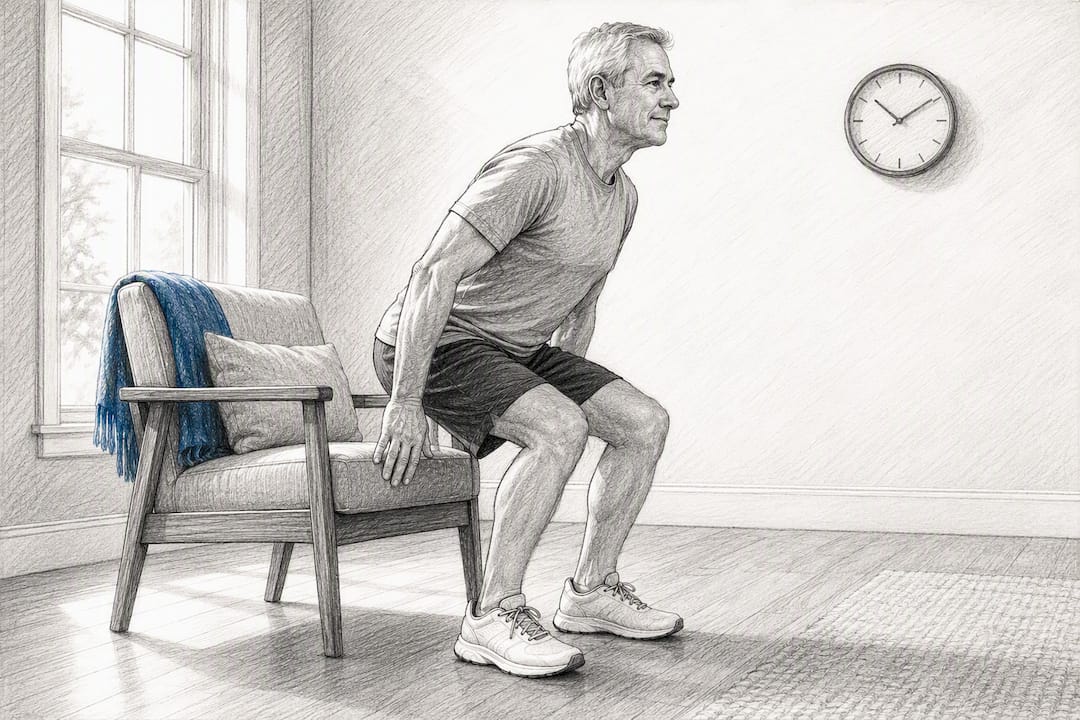
Think of your structured resistance and aerobic sessions as the stimulus that drives adaptation, and your daily movement as the environment that either supports or undermines it.
What to Actually Expect if You Start This Program
Realistic expectations save people from quitting at the exact moment progress is happening but invisible. In the first 4 to 6 weeks, expect strength and functional gains, an easier time with stairs, steadier balance, a faster sit-to-stand, well before you see or measure meaningful changes in muscle mass itself. That gap between feeling stronger and measuring more muscle is normal, not a sign the program isn’t working.
Safety and consistent measurement matter more than intensity in these early months. A moderate program you actually complete three times a week beats an aggressive one you abandon after two weeks of soreness. Retest your functional markers every 6 to 8 weeks rather than daily; day-to-day fluctuation in how you feel is normal and not a reliable signal of whether the program is working.
— Erik
Use The platform to Set a Real Baseline for Your Progress
Once you’re a few weeks into a resistance and aerobic routine, the natural next question becomes: is it actually working below the surface? Functional tests tell you a lot, but they can’t separate muscle gain from fat loss or fluid shifts the way a body-composition scan can. The platform solves that specific gap: a nationwide directory of 511 verified DEXA locations across 48 states where you compare transparent cash pricing before booking, with no physician referral required.

Think of a DEXA scan as a periodic check-in, not a replacement for the exercise and nutrition work that actually drives change. A baseline scan before you start your 12-week plan gives you a real number to compare against. Browse DEXA scan locations near you to compare pricing at verified clinics and book a baseline scan before you start tracking progress in earnest.
This article is general information, not a substitute for advice from a qualified doctor. Consult a qualified healthcare professional about your own circumstances before acting on anything here.
Sources
- Network meta-analysis: multicomponent exercise plus nutrition (2025)
- Optimizing prescription of resistance training in older adults (2025)
- Exercise for sarcopenia in older people: A systematic review and network meta-analysis (2023)
FAQ
What is the best exercise for sarcopenia?
Progressive resistance training is the single most effective exercise for sarcopenia, and combining it with aerobic and balance work produces the best overall functional results, according to network meta-analysis evidence.
What vitamin is good for sarcopenia?
Vitamin D supports muscle function, but supplementation only shows clear benefit for people who test as deficient, so a blood test should come before starting any supplement routine.
What foods can help reverse sarcopenia?
Protein-rich foods, lean meats, fish, eggs, dairy, and legumes, spread across multiple meals daily to reach at least 1.0 gram of protein per kilogram of body weight, support muscle maintenance most effectively when paired with resistance training.
Can a 77-year-old reverse sarcopenia?
Yes. Research on multicomponent programs shows meaningful improvements in strength, gait speed, and muscle mass in older adult populations, including those already showing signs of sarcopenia, when resistance training is paired with adequate protein intake.
How do I know if my program is actually working?
Retest gait speed, the five-times sit-to-stand, and grip strength every 6 to 8 weeks; if functional gains plateau or you want an objective read on muscle mass itself, a DEXA scan provides that precision.
Recommended
Medical Disclaimer: The information provided on this website is for general informational purposes only and is not intended as a substitute for professional medical advice, diagnosis, or treatment. Always seek the advice of your physician or other qualified health provider with any questions you may have regarding a medical condition. DEXA scan results should be interpreted by a qualified healthcare professional.