Did Weightlifting Raise Your Bone Density? DEXA at 511 U.S. Sites
Use a DEXA scan to see whether weightlifting changed your bone density. Read T scores, prep steps, retest timing, and book at 511 verified U.S. sites.
The objective measurement you want is a DEXA (DXA) bone density scan, the clinical standard for measuring bone mineral density. It reports your results as T-scores and Z-scores, flags whether you fall into normal, osteopenia, or osteoporosis ranges, and feeds directly into fracture-risk decisions. This guide covers preparation, interpretation, screening timelines, limitations, and how to actually book one.
TL;DR:
- A DEXA scan is the most accurate, low-radiation test for measuring bone mineral density at the spine and hip, crucial for fracture risk assessment.
- Preparation requires stopping calcium supplements 24–48 hours beforehand and avoiding contrast imaging within two weeks if recently performed.
- Resistance exercises, especially compound lifts like squats and deadlifts that load the spine and hips, can improve bone density over months or years.
- Factors such as spinal deformities, prior surgery, or osteoarthritis may distort DEXA results, requiring alternative assessments like QCT in some cases.
- Screening is recommended for women over 65 and men over 70, but earlier testing is advised if risk factors like prior fractures or steroid use are present.
Table of Contents
- What Is a DEXA Bone Density Scan?
- How Do You Prepare for a DEXA Scan?
- How Do You Read T-Scores and Z-Scores?
- Who Should Get a DEXA Scan, and When?
- What Are DEXA’s Limitations, and When Do You Need Something Else?
- How Do You Find and Book a DEXA Scan?
- What Does the Research Say About Weightlifting and Bone Density?
- Why Does Lifting Weights Affect Bone at All?
- Which Weightlifting Exercises Help Bone Density Most?
- How Often and How Heavy Should You Lift for Bone Health?
- What Precautions Apply If You Already Have Low Bone Density?
- How Does Weightlifting Compare to Other Exercise for Bone Density?
- A Final Note on Tracking Your Own Numbers Over Time
- Book a DEXA Scan Through Dexascans.com
- Sources
- FAQ
What Is a DEXA Bone Density Scan?
Dual-energy X-ray absorptiometry, shortened to DEXA or DXA, sends two low-dose X-ray beams through bone and soft tissue to calculate how much mineral is packed into your skeleton. Denser bone absorbs more radiation; the machine measures the difference and converts it into a bone mineral density value. This is the test most clinical guidance points to as the most accurate way to screen for osteoporosis.
There are two flavors worth knowing about:
- Central DXA scans the lumbar spine and hip. It’s the gold standard for predicting fracture risk at the sites where fractures actually do the most damage.
- Peripheral devices scan the wrist, finger, or heel. They’re faster and often show up at health fairs, but they’re less precise for tracking changes over time.
A scan itself takes 5 to 10 minutes and delivers a radiation dose well below a standard chest X-ray. One caveat worth remembering: DEXA estimates fracture risk based on bone quantity. It doesn’t capture every factor in bone quality, so a normal score isn’t an absolute guarantee against fracture, and a low score isn’t a certainty of one either.
How Do You Prepare for a DEXA Scan?
Preparation is minimal, but skipping a step can force a rescheduled appointment. Here’s the short list:
- Stop calcium supplements for 24 to 48 hours before your scan, since residual calcium in the digestive tract can skew readings, per UC Davis Radiology.
- Tell the technologist about any recent contrast imaging. A CT scan with contrast or a barium study can bias the results, and you may need to wait 10 to 14 days before scanning.
- Confirm you’re not pregnant. Facilities generally won’t scan a pregnant patient unless there’s a specific clinical reason to proceed.
- Wear clothing without metal (zippers, buttons, underwire) and bring any prior bone density reports for comparison.
Expect the appointment itself to run 5 to 10 minutes, most of it spent lying still on a padded table.
How Do You Read T-Scores and Z-Scores?
Your report will show either a T-score, a Z-score, or both, and the difference matters more than most people realize. A T-score compares your bone density to a healthy 30-year-old adult of the same sex, and it’s the number used for adults 50 and older. A Z-score compares you to people your own age, which is the more useful figure for younger patients, since comparing a 28-year-old to a 30-year-old baseline tells you almost nothing a T-score wouldn’t already show.
T-score thresholds, per MedlinePlus:
- Normal: T-score of -1 or higher
- Osteopenia (low bone mass): T-score between -1 and -2.5
- Osteoporosis: T-score of -2.5 or lower
These numbers drive real decisions. A score in the osteopenia range might trigger lifestyle counseling and a repeat scan down the road. A score at or below -2.5 typically opens a conversation about medication, fall prevention, and closer monitoring.
Retest intervals follow your risk level, and Mayo Clinic’s guidance is a reasonable benchmark: roughly every 2 years for high-risk patients, 3 to 5 years for moderate risk, and 10 to 15 years for people who scored well within the normal range and have no major risk factors.
One detail that trips people up: if a peripheral device (the kind at a health fair or gym) flags a low result, that’s a screening signal, not a diagnosis. It should prompt a follow-up with a central DXA of the hip and spine, which is far more reliable for actual clinical decisions.
Who Should Get a DEXA Scan, and When?
Standard screening guidance targets two groups by default: women age 65 and older, and men age 70 and older. But age alone isn’t the whole picture. Mayo Clinic notes that people with specific risk factors should test earlier, sometimes decades earlier, regardless of age.
Risk factors that move up the timeline include:
- A prior fragility fracture (breaking a bone from a fall that shouldn’t have caused one)
- Long-term corticosteroid use, which accelerates bone loss
- Low body weight or a history of eating disorders
- Endocrine conditions like hyperthyroidism, or rheumatologic disease such as rheumatoid arthritis
- Hormone loss from cancer treatment, early menopause, or surgical removal of the ovaries
None of these guarantee a diagnosis. They’re reasons to have the conversation with a clinician sooner rather than waiting for a birthday to make the decision. If you check two or three boxes on that list at age 45, that’s a legitimate reason to ask about testing now rather than waiting 20 years for the standard screening age to catch up. Our complete guide to bone density testing breaks down cost and scoring in more depth if you’re deciding whether to move forward.
What Are DEXA’s Limitations, and When Do You Need Something Else?
DEXA is reliable, but it’s not immune to interference. Spinal deformities, prior spine surgery with hardware, and even common osteoarthritis can artificially inflate lumbar spine readings, making bone look denser than it really is. A technologist reviewing your scan should flag this, but it’s worth asking about directly if you have any spinal history.
Peripheral devices have their own ceiling. They’re fine for a quick screen, but central DXA of the hip and spine remains the preferred method for monitoring how well a treatment is working, because it’s more sensitive to small changes over time.
When DXA results are inconsistent with a patient’s clinical picture, or when severe deformity makes the spine unreadable, quantitative CT (QCT) is sometimes used as an alternative. It’s more expensive and delivers more radiation, so it’s reserved for specific cases rather than routine screening.
Pro Tip: If you’ve had spinal fusion hardware or significant scoliosis, mention it when booking. Some facilities will scan the forearm instead of the spine to get a cleaner reading.
How Do You Find and Book a DEXA Scan?
Finding a DEXA scan used to mean waiting on a physician referral and hoping your insurance covered it at a reasonable rate. That’s no longer the only path.
- Search by city or ZIP code on a platform like Dexascans, which lists over 511 verified locations across 48 states, and filter for central DEXA or bone density testing specifically.
- Compare cash pricing before you book. Some platforms emphasize transparent pricing that can be lower than typical hospital rates, and many locations don’t require a physician referral.
- Confirm exactly what’s included. Some appointments cover bone density only; others bundle in body composition scanning as well, since DEXA can measure body fat and lean mass alongside bone. Ask for a copy of your report with T-scores and Z-scores clearly listed so you have a baseline for future comparisons.
Booking directly and paying cash is often faster than routing through a referral system, especially if your only goal is a baseline measurement rather than a diagnostic workup tied to a specific complaint.
What Does the Research Say About Weightlifting and Bone Density?
Resistance training’s effect on bone mineral density is one of the more consistent findings in exercise science, though the size of the effect depends heavily on age, hormonal status, and training history. Studies in postmenopausal women, a group especially prone to rapid bone loss, have repeatedly shown that structured resistance programs can slow or partially reverse density loss at the hip and spine, the same two sites a central DEXA scan measures. The effect tends to be site-specific: loading the hip through squats or deadlifts influences hip density more than it influences the wrist, for example.
Younger and premenopausal populations show smaller but still measurable gains, largely because their baseline bone turnover is already more favorable. Athletes in high-impact, load-bearing sports like weightlifting and gymnastics consistently show higher bone density than athletes in non-impact sports like swimming, a pattern researchers have documented across many cohort comparisons.
None of this makes exercise science a substitute for direct measurement. A training program can plausibly move the needle on bone density, but the only way to know whether it actually did, for you specifically, is to measure before and after with the same test. That’s the practical link between the two topics: lifting is a strategy, DEXA is the scoreboard. Without a baseline scan and a follow-up scan, you’re relying on population averages to describe an individual outcome, which is a poor substitute for your own data.
Why Does Lifting Weights Affect Bone at All?
Bone isn’t static. It’s living tissue that responds to mechanical stress through a process called bone remodeling, where osteoclasts break down old bone and osteoblasts build new bone in its place. Under normal conditions, that cycle stays roughly balanced. Add a mechanical load heavier than what the skeleton normally experiences, and the balance tips toward building.
The mechanism most often cited is Wolff’s Law, the century-old observation that bone adapts its internal structure to the loads placed on it. Mechanical stress on bone tissue triggers osteocytes, the sensor cells embedded throughout bone, to signal osteoblasts to lay down additional mineral at the stressed site. Heavier, more novel loads tend to produce a stronger signal than light, repetitive ones, which is part of why walking alone rarely produces the same skeletal response as resistance training.
Muscle contraction itself also pulls directly on the bones it attaches to, and that pulling force is a distinct stimulus from the compressive force of body weight or an external load. This is why a compound lift that recruits large muscle groups and forces the skeleton to stabilize against real resistance tends to produce a broader remodeling response than movements that isolate a single small muscle. The catch is that this remodeling process is slow. Meaningful density change typically shows up over many months to a few years, not weeks, which is exactly why a single scan can’t confirm a trend. You need a starting point and at least one follow-up to see the biology actually reflected in a number.
Which Weightlifting Exercises Help Bone Density Most?
Not all resistance exercise carries equal weight, literally. Movements that load the spine and hip axially, the same regions a central DEXA scan targets, tend to produce the most relevant density response for fracture prevention.
Compound, weight-bearing lifts sit at the top of that list:
- Back squats and front squats load the hip and lumbar spine directly through axial compression.
- Deadlifts combine hip loading with a strong pulling force through the posterior chain.
- Overhead presses load the shoulders and, through postural stabilization, the thoracic spine.
- Weighted step-ups and lunges load the hip unilaterally, which some research suggests may address side-to-side density differences.
Isolation exercises like leg extensions or bicep curls aren’t harmful, but they don’t recruit the same skeletal stabilization demand, so their contribution to density is smaller. Impact-based movements, like jump training or plyometrics, layered on top of a lifting program add a ground-reaction-force component that pure lifting doesn’t replicate, which is part of why many bone-focused programs pair the two.
The practical takeaway isn’t to chase a perfect exercise list. It’s to prioritize compound, progressively loaded lifts that stress the hip and spine, since those are the regions where a future DEXA scan will actually be measuring change.
How Often and How Heavy Should You Lift for Bone Health?
Frequency and intensity matter more than total volume when the goal is bone density rather than muscle size. Most research protocols showing measurable density improvements used sessions two to three times per week, with at least one rest day between sessions targeting the same muscle groups to allow the remodeling response to actually occur.
Intensity is where a lot of well-intentioned programs fall short. Light, high-repetition training with minimal resistance produces a much smaller osteogenic signal, even if it builds cardiovascular fitness or muscular endurance.
Duration matters too, but not in the way people expect. Bone remodeling operates on a timeline of months, not weeks. Most protocols showing statistically observable density change ran for a minimum of six months, with the clearest results typically appearing after a year or more of consistent training. This is precisely why tracking progress with a single measurement doesn’t work. It takes a baseline DEXA scan, a sustained training block, and a follow-up scan at an appropriate interval to see whether a specific program actually moved bone density, as opposed to just muscle mass or body composition.
Progressive overload, gradually increasing the load over time rather than repeating the same weight indefinitely, is the mechanism that keeps the stimulus effective as the skeleton adapts.
What Precautions Apply If You Already Have Low Bone Density?
Lifting with osteopenia or osteoporosis isn’t off the table, but the approach changes, and the stakes for getting form wrong are higher. Fragile bone under excessive or poorly controlled load carries a real fracture risk, particularly at the spine, so this is a situation where professional guidance matters more than a generic program.
A few precautions apply broadly:
- Avoid high-flexion spinal loading, like weighted sit-ups or toe touches under load, since forward spinal flexion combined with compression is a known risk pattern for vertebral fracture in people with low bone density.
- Skip high-impact jumping movements until a clinician or physical therapist confirms your fracture risk is low enough to tolerate them.
- Start with supervised, lower-intensity loading and progress gradually, rather than jumping straight into heavy compound lifts.
- Get medical clearance first if you’ve already been diagnosed with osteoporosis or have a prior fragility fracture, since the safe starting intensity varies significantly by individual.
This caution applies symmetrically to anyone managing a diagnosed bone-loss condition, whether the concern is a specific lift, a jumping movement, or a general increase in training intensity. The safest path for someone with a T-score in the osteoporosis range is a program designed around their actual scan results, not a generic template built for someone with normal bone density. That’s another point in favor of getting scanned before overhauling a training program, not after.
How Does Weightlifting Compare to Other Exercise for Bone Density?
Not every form of exercise carries the same skeletal payoff, and the differences are large enough to matter when choosing how to spend limited training time. Weight-bearing, high-impact, or resistance-based activities consistently outperform non-impact cardiovascular exercise for bone density specifically, even when the non-impact activity is excellent for cardiovascular health.
Swimming and cycling are the clearest examples of the gap. Both are outstanding for cardiovascular fitness and joint-friendly for people with existing injuries, but neither loads the skeleton against gravity in a meaningful way, and studies of competitive swimmers and cyclists have repeatedly found bone density at or below that of sedentary control groups at certain sites. Walking sits in the middle. It’s weight-bearing, so it beats swimming for skeletal benefit, but the forces involved are far lower than what running, jumping, or lifting produce, so its density benefit is comparatively modest.
Running and other impact sports generate strong ground-reaction forces that do stimulate bone, particularly in the lower body, but they don’t load the upper body or spine the way a deadlift or overhead press does. Resistance training’s advantage is its versatility: you can direct the load at whichever region needs it most; the hip, the spine, the wrist, by choosing the right lift.
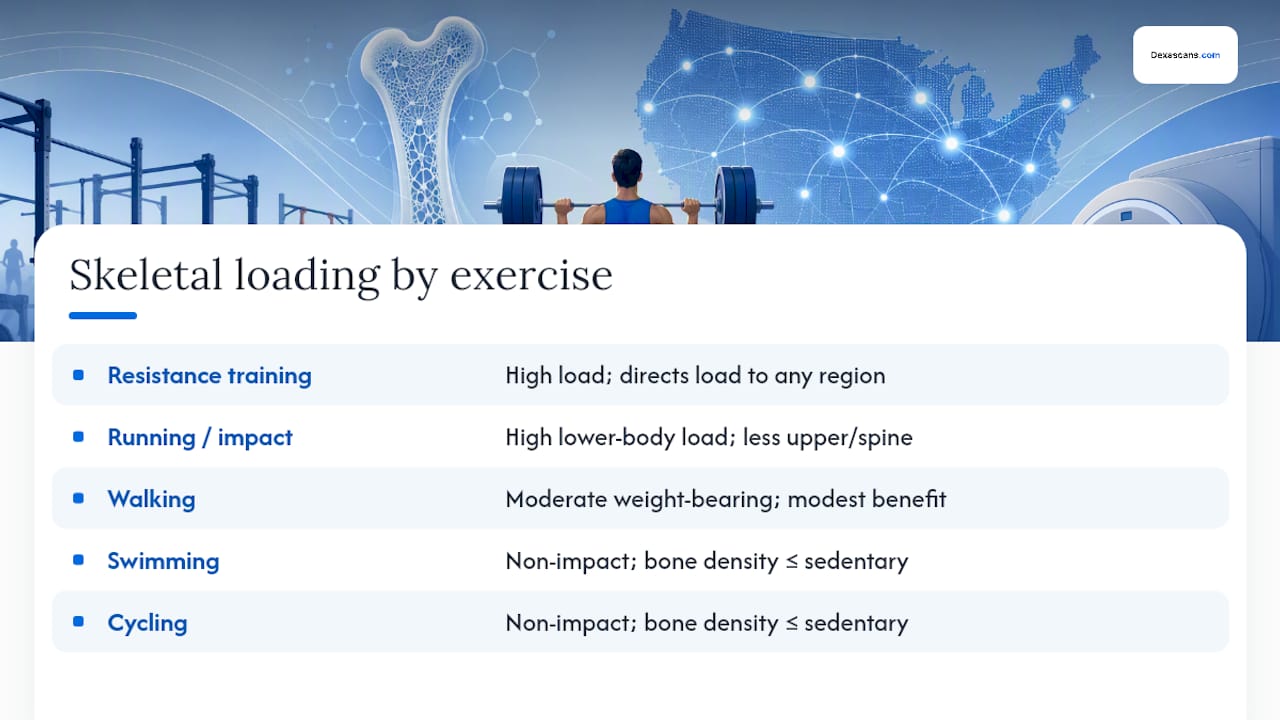
The practical implication is that a well-rounded approach to skeletal health probably combines resistance training with some impact activity, rather than relying on one modality alone. But regardless of which combination someone chooses, the only way to know if it’s actually working at their specific hip and spine is the same test discussed throughout this guide.
A Final Note on Tracking Your Own Numbers Over Time
If you’re using DEXA to track progress rather than just get a one-time diagnosis, consistency matters as much as the scan itself. Small changes in bone density can be within a machine’s margin of error, so using the same facility and, where possible, the same scanner for follow-up testing gives you a cleaner comparison than switching locations every time.
— Erik
Book a DEXA Scan Through Dexascans.com
There are online marketplaces for finding and comparing DEXA providers, which list numerous verified locations across many states and show transparent cash pricing so you can compare costs before booking.
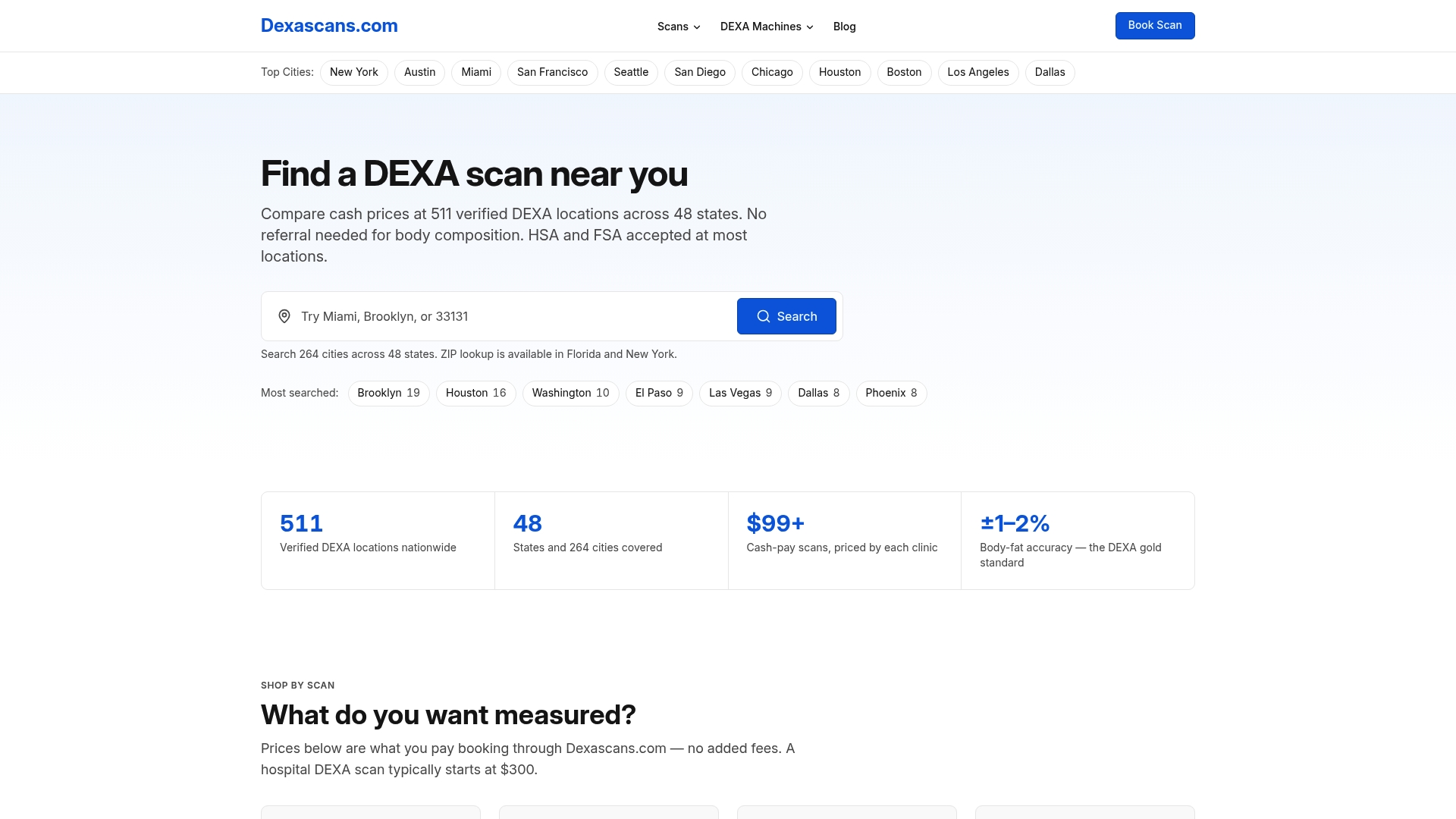
If you’ve read through the scoring thresholds above and want your own numbers, start at the DEXA scan locations page and search by city or ZIP. Filter for bone density testing, compare a few nearby options on price, and book directly; most listed locations don’t require a physician referral. For a deeper walkthrough of what your appointment will include, the complete guide to DEXA scans covers what to expect before you show up.
This article is general information, not a substitute for advice from a qualified doctor. Consult a qualified healthcare professional about your own circumstances before acting on anything here.
Sources
- Bone density scans (DEXA): what they show about your osteoporosis risk — URMC
- DEXA scan - UC Davis Radiology
- Bone density scan — MedlinePlus
- Bone density scan (DEXA) — RadiologyInfo
- Bone density test — Mayo Clinic
FAQ
Does DEXA or DXA Refer to a Different Test?
No, they’re the same test. Clinical sources use DEXA and DXA interchangeably, both referring to dual-energy X-ray absorptiometry.
How Much Radiation Does a DEXA Scan Involve?
DEXA uses a very low radiation dose, often less than one-tenth of a standard chest X-ray, according to UC Davis Radiology. That low exposure is part of why it’s used so widely for routine screening.
Can I Get a DEXA Scan Without a Doctor’s Referral?
Yes, in most cases. Many locations listed on Dexascans allow direct booking with transparent cash pricing and no referral requirement, though policies vary by clinic.
What Counts as a Low Bone Density Score?
A T-score between -1 and -2.5 indicates osteopenia, or low bone mass, while a T-score of -2.5 or lower indicates osteoporosis, per MedlinePlus. A score of -1 or higher is considered normal.
How Often Should I Get a Follow-Up Bone Density Scan?
It depends on your risk level. Mayo Clinic guidance suggests roughly every 2 years for high-risk patients, 3 to 5 years for moderate risk, and 10 to 15 years for low-risk individuals with normal baseline results.
Recommended
Medical Disclaimer: The information provided on this website is for general informational purposes only and is not intended as a substitute for professional medical advice, diagnosis, or treatment. Always seek the advice of your physician or other qualified health provider with any questions you may have regarding a medical condition. DEXA scan results should be interpreted by a qualified healthcare professional.