Visceral Belly Fat: What It Is, How to Measure and Reduce It
Visceral belly fat sits deep around your organs. Learn how it differs from pinchable fat, what your waist and a DEXA scan reveal, and how to reduce it.
Visceral belly fat is the fat stored deep inside your abdomen, wrapped around the liver, intestines and other organs. It is not the soft layer you can pinch. You can’t judge it by looking in a mirror or stepping on a scale, but you can track it: a tape measure gives a first signal, and a DEXA scan gives a number you can compare from one visit to the next. You can book a scan without a referral at Dexascans.com, which lists 511 verified locations in 48 states.
TL;DR
- Visceral fat lies beneath the abdominal wall around your organs. Subcutaneous fat lies under the skin. They behave differently in the body.
- Excess visceral fat is linked to heart disease, type 2 diabetes and fatty liver, and people at a healthy weight can carry too much of it.
- A waist of 35 inches or more (women) or 40 inches or more (men) is a first warning sign. A DEXA scan estimates visceral fat directly.
- Weight loss through a modest calorie deficit, regular aerobic activity and strength training is the evidence-based way to reduce it.
- Repeat scans under the same conditions show whether your plan is working, even when the scale barely moves.
Table of Contents
- What visceral belly fat is, and how it differs from the fat you can pinch
- Why it matters for your health
- How to tell if you have too much
- What a DEXA scan shows about visceral fat
- Making sense of a visceral fat score
- Book a scan without the insurance hassle
- How to reduce visceral belly fat
- What recent U.S. guidance says
- FAQ
- Sources
What visceral belly fat is, and how it differs from the fat you can pinch
Your body stores fat in two main places around the midsection. Subcutaneous fat sits just under the skin. It is the layer you can grab with your fingers. Visceral fat sits deeper, in the abdominal cavity, beneath the abdominal muscles and around organs such as the liver and intestines.
The two are not equal in how they act. A 2024 review in Biochemical Pharmacology reports that visceral fat is a small depot, about 5 to 10 percent of total body fat in women and 10 to 20 percent in men. Even so, it is independently associated with cardiometabolic disease. The reason is largely anatomical. Blood from visceral fat drains through the portal vein straight to the liver, so the liver receives whatever that fat tissue releases.
This also explains why “visceral stomach fat” and “visceral fat” mean the same thing in everyday searches. A firm, round belly can point to visceral fat, while a soft, pinchable belly is usually more subcutaneous. But only imaging can tell you for sure, and many people carry both.
Why it matters for your health
The main concern is what dysfunctional visceral fat releases. According to the same 2024 review, it secretes elevated fatty acids, glycerol and inflammatory signaling molecules into the portal vein. This affects the liver directly and can contribute to fat buildup in the liver, insulin resistance and wider metabolic problems.
A 2019 position statement from the International Atherosclerosis Society, published in The Lancet Diabetes & Endocrinology, describes visceral adipose tissue as an independent risk marker of cardiovascular and metabolic illness and death. It adds that at any body mass index (BMI), excess visceral fat is often associated with fat deposits in the heart, liver and skeletal muscle.
That last point matters if you consider yourself fit or “normal weight.” The American Heart Association’s 2021 statement, summarized in its news release, says belly fat is a clear health hazard and that even healthy-weight people can have increased heart disease risk. Experts recommend checking both abdominal measurements and BMI at regular visits.
In practical terms, the conditions most tied to excess visceral fat are:
- Heart and blood vessel disease
- Type 2 diabetes and insulin resistance
- Fatty liver disease
- Unfavorable blood fats, such as high triglycerides
This is information for planning, not a diagnosis. If you have symptoms or a family history of these conditions, talk to your doctor about your numbers.
How to tell if you have too much
Start with a tape measure
The simplest check is your waist. The National Institute of Diabetes and Digestive and Kidney Diseases (NIDDK) says a waist of at least 35 inches in women or 40 inches in men raises the risk of obesity-related health problems. It also notes that some people of Asian ancestry store extra fat around the waist and face higher risk even when BMI is not high.
To measure, stand up, breathe out normally and wrap a flexible tape around your bare midsection at the level of your navel, snug but not squeezing. Take it at the same time of day each time.
Waist-to-height ratio is another quick check. The American Diabetes Association (ADA) standards use a ratio of 0.5 or higher, alongside BMI of 25 or more, as one way to flag excess adiposity in non-Asian adults.
Know what a tape measure can’t tell you
The 2025 VA/DoD clinical practice guideline says waist circumference and waist-to-hip ratio are more accurate than BMI for spotting increased body fat, but they cannot reliably separate visceral from subcutaneous fat in an individual. Your waist could be large because of either type. That is why people who want a clearer answer turn to imaging.
Imaging options
CT and MRI are the reference methods for abdominal fat. The ADA notes that they accurately distinguish subcutaneous from visceral tissue but are used mainly in research because of cost and practicality. DEXA and bioelectrical impedance devices (the handheld or standing scales that send a small current through the body) can assess body composition in everyday settings.
A 2025 academic review explains that DXA is a two-dimensional technique, yet its visceral fat estimates correlate strongly with MRI measurements. The same review notes that impedance devices may underestimate visceral fat in people who have higher levels. For a repeatable, accessible number, DEXA is the practical choice.
What a DEXA scan shows about visceral fat
A DEXA scan uses very low-dose X-rays at two energy levels to separate bone, lean mass and fat. A body composition scan reports total body fat percentage, how much fat and lean tissue sits in each region, and an estimate of visceral adipose tissue (VAT). According to a 2021 paper in Frontiers in Rehabilitation Sciences, common DEXA software estimates visceral fat by subtracting the subcutaneous fat in the abdomen from the fat in the android (belly) region.
That gives you things a scale and a tape cannot:
- Where your fat is. Two people at the same weight can have very different visceral amounts.
- What changed. If you lose weight, you can see whether it came from fat or from muscle.
- A trend. A repeat scan under the same conditions shows direction, which is what matters for visceral fat.
For a deeper look at which numbers to watch, see our guide to body composition metrics, including VAT and ALMI. If your goal is muscle gain, what a DEXA scan shows about muscle covers lean mass in detail.
Plan your appointment well. Our own guidance on measuring visceral fat reliably with DEXA covers how to book without a referral and prepare so your results are comparable next time. Keep the same routine: similar time of day, similar hydration, and no heavy meal or hard workout right before.
Making sense of a visceral fat score
Readers often ask whether a score like 4.5 is good. The honest answer is that it depends on the device and the unit. Some scales and impedance devices give a unitless rating on a small scale. DEXA software reports visceral fat as a mass, a volume or an area in square centimeters. The numbers are not interchangeable.
For area-based results, the 2021 Frontiers paper reports that studies suggest a visceral fat area of 100 to 159 cm² indicates increased cardiometabolic risk and 160 cm² or more indicates high risk. Your report may use different units, so read the legend on your own scan and ask the clinic which software produced it. We explain the ranges in what your visceral fat score means.
Two habits make scores useful:
- Compare scans only from the same machine and software.
- Look at the change over months, not a single reading in isolation.
The Obesity Medicine Association’s 2022 clinical statement adds that percent body fat alone does not describe the android and visceral fat depots, which are the ones most tied to cardiometabolic risk. That is a good reason to look at the regional breakdown on your report and not only the headline percentage.
Book a scan without the insurance hassle
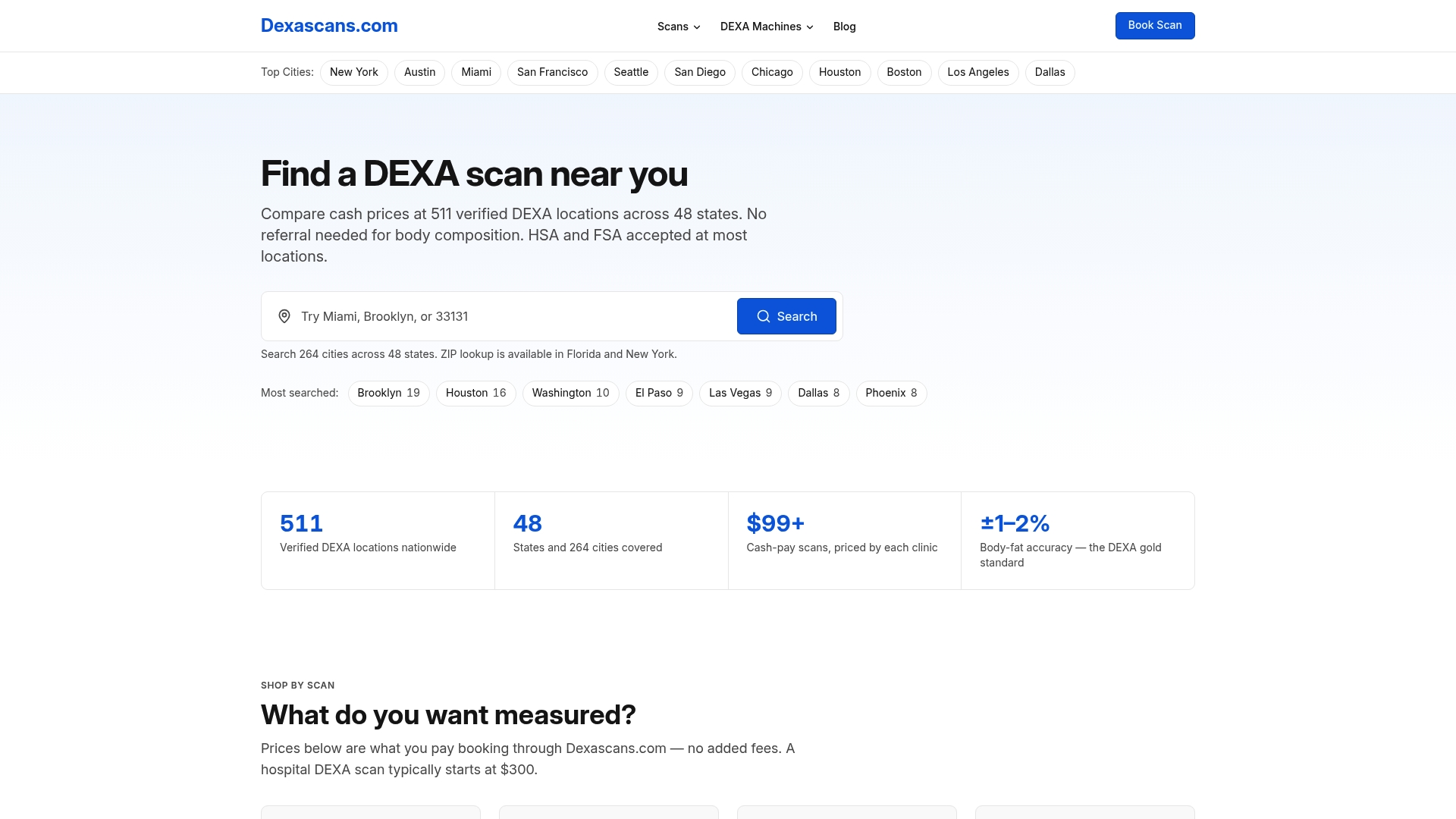
Dexascans.com is a platform for finding and comparing DEXA clinics across the U.S. You search by city or ZIP, compare cash prices, check which scan types each location offers (full-body composition, bone density, combined appointments, and VO2 max and resting metabolic rate add-ons) and book directly with the clinic, with no physician referral needed. Every listed location is verified, and listing prices are cash prices.
Start with our body composition scan page for cost, accuracy and where to book. If you are also thinking about bone health, the same visit can often be combined with a bone density test, and our bone density test page explains T-scores and where to get one. Prefer to go local? We list clinics in places like Dublin, Ohio.
How to reduce visceral belly fat
There is good news here. Visceral fat responds to the same fundamentals as overall weight loss, and the guidelines agree on the basics. The 2025 VA/DoD guideline calls reducing visceral fat particularly important because of its links to chronic inflammation, insulin resistance, abnormal blood fats and cardiovascular disease.
Eat in a modest deficit
The guideline recommends a dietary approach that creates an energy deficit of 500 to 750 kcal per day, and it finds no single diet superior to another. The best plan is the one you can follow for months. Mayo Clinic’s guidance on belly fat points to a plant-focused diet, portion control and replacing sugary drinks.
Move on a schedule
The same VA/DoD guideline recommends structured physical activity: roughly 150 to 225 minutes a week of moderate activity for small weight loss, and 225 to 420 minutes a week for moderate loss, with strength training and between 2,600 and 10,000 steps per day. The federal baseline of 150 minutes of moderate or 75 minutes of vigorous aerobic activity plus strength training twice a week is a sound starting point. If you have a heart condition, are new to exercise or take medication that affects blood sugar, check with your doctor before ramping up.
Set realistic targets
The VA/DoD guideline notes that 5 percent weight loss improves blood sugar control, triglycerides, blood pressure and HDL cholesterol. About 10 percent or more is often needed for meaningful gains in sleep apnea and fatty liver disease, and more than 15 percent is frequently associated with type 2 diabetes remission. For a 200-pound person, 5 percent is 10 pounds. That is a visible, measurable first goal.
Track what the scale misses
Body weight can hide the story. If you are lifting weights while cutting calories, you may gain muscle while losing fat, and the scale shifts little. A DEXA scan every few months shows total fat, regional fat and lean mass together, so you know the work is going to the right place. Our guide to tracking real fat loss with DEXA scans shows how to space scans and read the changes. Athletes who want to understand what a scan can and cannot say about physique can read DEXA for bodybuilding.
What recent U.S. guidance says
The 2025 VA/DoD guideline, discussed in an Annals of Internal Medicine update, encourages clinicians to consider waist circumference, waist-to-hip ratio or waist-to-height ratio alongside BMI. It also observes that DXA-derived visceral fat may predict cardiometabolic disease better than BMI or waist measures in observational studies. In practice, this means a waist check plus a body composition scan gives a fuller picture than BMI alone. Our article on waist size and visceral fat risks explains what to bring to a conversation with your clinician.
Our view: measure it, then manage it
We built Dexascans.com around a simple observation: people can’t act on what they can’t see. Visceral fat is the clearest example. It is hidden, it matters, and a scale will not report it.
A DEXA scan, with body fat precision of about ±1 to 2 percent, turns a vague worry about your belly into numbers you can track. We list 511 verified locations in 48 states, show cash pricing, and let you book directly with the clinic without a referral, so getting a baseline is not a project.
Our advice is to scan once to learn where you start, make one or two sustainable changes, and scan again on the same machine. The comparison is where the value is, and it keeps your effort pointed at what changes your health, not at the number on the scale.
Erik
FAQ
How do I get rid of visceral belly fat?
The evidence supports a modest calorie deficit of about 500 to 750 kcal a day, regular aerobic activity, strength training twice a week and steady habits. Spot exercises like crunches do not target it. Losing weight overall is what reduces it, and a follow-up scan shows your progress.
Is a visceral fat score of 4.5 good?
It depends on the device. Scales and handheld units often use a unitless rating, while DEXA reports an area or volume. For DEXA area measurements, studies suggest 100 cm² and above indicates increased cardiometabolic risk. Check the scale printed on your own report and compare only with scans from the same machine.
Can I have visceral fat if I am not overweight?
Yes. The International Atherosclerosis Society notes that at any BMI, excess visceral fat is often linked to fat in the liver, heart and muscle. The American Heart Association also says healthy-weight people can have raised heart risk from belly fat. A waist measurement or a DEXA scan can show where you stand.
Do I need a referral for a DEXA scan?
Not through Dexascans.com. You can search by city or ZIP, compare cash prices and book directly with a listed clinic without a physician referral. Share your results with your doctor if you have health concerns.
Sources
- The pathophysiology of visceral adipose tissues in cardiometabolic diseases (Biochemical Pharmacology, 2024)
- Visceral and ectopic fat, atherosclerosis, and cardiometabolic disease (The Lancet Diabetes & Endocrinology, 2019)
- American Heart Association: too much belly fat, even with a healthy BMI (2021)
- NIDDK: Am I at a healthy weight?
- VA/DoD Clinical Practice Guideline for Management of Overweight and Obesity in Adults (2025)
- Evolving perspectives on evaluating obesity (2025)
- ADA: Screening, Diagnosis, Evaluation, and Staging of Obesity (2026)
- DXA-Derived Adiposity and Lean Indices (Frontiers in Rehabilitation Sciences, 2021)
- Obesity Medicine Association Clinical Practice Statement (2022)
- Adult Overweight and Obesity Management: Updates (Annals of Internal Medicine)
- Mayo Clinic: belly fat and how to lose it
Recommended
Medical Disclaimer: The information provided on this website is for general informational purposes only and is not intended as a substitute for professional medical advice, diagnosis, or treatment. Always seek the advice of your physician or other qualified health provider with any questions you may have regarding a medical condition. DEXA scan results should be interpreted by a qualified healthcare professional.