Private DEXA Scan: Costs, Referrals and How to Book Self-Pay
A private DEXA scan lets you pay cash and book without insurance. See what it costs, which scan you need, how referrals work and how to compare clinics.
A private DEXA scan is one you book and pay for yourself, usually at an outpatient imaging center or a body composition clinic, without going through insurance. For body composition you rarely need a doctor’s order. For a diagnostic bone density scan you often do, but many clinics arrange that for you. The cash price depends mostly on the clinic type, so comparing by ZIP code is the fastest way to avoid paying hospital rates. Dexascans.com lists over 511 verified locations in 48 states where you can book directly.
TL;DR
- “Private” and “self-pay” mean you pay the clinic directly. Cash prices vary widely, and our cash price comparison shows scans ranging from about $40 to $400 depending on the facility.
- A body composition scan measures fat, lean mass and often bone. A bone density scan screens for osteoporosis and uses T-scores. Combined appointments exist.
- Medicare and most plans cover screening for people who qualify, so paying cash makes the most sense when you want a scan for tracking, you don’t qualify, or you want to skip the paperwork.
- Bring the same prep every time (same hydration, same clothing, ideally the same machine) so your repeat scans are comparable.
- Children are scanned differently from adults, and the results are read differently too.
Table of Contents
- What a private DEXA scan actually means
- What a self-pay DEXA scan costs
- Body composition scan or bone density scan?
- Who should consider a bone density scan
- Do you need a referral?
- Before and during your scan
- Reading your results and repeating the scan
- Private bone density scans for children
- How to compare private DEXA clinics
- Find a private DEXA scan near you
- FAQ
- Sources
What a private DEXA scan actually means
DEXA (also written DXA) is dual-energy X-ray absorptiometry. It uses two very low-dose X-ray beams to separate bone, fat and lean tissue. You lie on a padded table for roughly 10 to 20 minutes while an arm passes over you. See our walkthrough of the DEXA scan procedure for the full sequence.
In a hospital, the scan is usually ordered by a physician, billed through insurance and priced from a chargemaster list. In a private setting, you choose the clinic, see a flat price and pay at the visit. That is the whole difference. The machine and the physics are the same.
People go this route for three common reasons:
- Tracking. Lifters, athletes and people on a weight-loss plan want body fat and lean mass numbers, which insurance does not cover.
- Speed. Booking directly avoids waiting for a referral and a hospital scheduling slot.
- Cost certainty. A high-deductible plan or no coverage makes a posted cash price easier to plan around.
What a self-pay DEXA scan costs
Cash prices differ by scan type and by who runs the clinic. Discretionary Health’s dataset, as of November 16, 2026, puts the national average cash price at $228.29 for clinical bone density scans across 1,017 priced locations, and $199.22 for body composition scans across 468 locations. These averages move as clinics update their pricing, so treat them as a snapshot, not a quote.
The spread around those averages is large. Our own comparison of body composition scan costs shows cash prices running from roughly $40 at high-volume studios to about $400 at some medical settings, with add-ons such as VO2 max and resting metabolic rate testing raising the total.
What to check on any price before you book:
- What is included. A body composition report, a bone density report, or both.
- Who reads the result. Diagnostic bone density results should come with a radiologist’s interpretation. Body composition reports are often generated by the software.
- Extra fees. A flat cash price with no facility fee or separate radiology bill is the cleanest.
- Package pricing. If you plan to rescan every few months, a multi-scan package can lower the cost per scan.
- HSA or FSA use. Some clinics provide itemized receipts. Ask the clinic what it can document.
To see prices side by side for your area, use our DEXA scan cost page and search by city or ZIP.
Body composition scan or bone density scan?
This is the choice that decides your price, your paperwork and what you get back.
| Body composition scan | Bone density scan | |
|---|---|---|
| What it measures | Total and regional fat mass, lean mass, body fat percentage, often an estimated visceral fat figure | Bone mineral density at the hip and lumbar spine |
| Main reports | Body fat %, lean mass, fat distribution | T-score and Z-score |
| Typical reader | Fitness trackers, athletes, weight management | People screening for osteoporosis or low bone mass |
| Referral | Usually not needed | Often needed for a diagnostic read, depending on the clinic |
A combined appointment gives you both in a single visit. Many clinics on our platform list full-body composition, bone density and combined options, so you can see which they offer before you book. Our pages on the body composition scan and the bone density test explain the reports in more detail.
One point trips people up: a total-body scan includes a bone number, but it is not the same as the hip and spine measurement that doctors use to diagnose osteoporosis. If your goal is a diagnosis or a treatment decision, book the bone density study.
On precision, DEXA measures body fat with an error margin of roughly 1 to 2 percentage points when conditions are consistent, which is why it is a favorite for tracking change over months.
Who should consider a bone density scan
The U.S. Preventive Services Task Force’s January 2025 recommendation gives a grade B to screening with DXA for women 65 and older, and for postmenopausal women under 65 who are at increased risk based on a clinical risk assessment. For men, the Task Force’s statement remains an “I” statement, meaning the evidence is currently insufficient to weigh benefits and harms. The update also allows screening with DXA with or without a separate fracture risk assessment.
Medicare has its own rules. The CMS Medicare Benefit Policy Manual says Medicare pays for a bone mass measurement every two years, or more often when medically necessary, for beneficiaries who meet at least one listed condition. Those include estrogen deficiency with clinical risk for osteoporosis, vertebral abnormalities on X-ray, long-term glucocorticoid therapy, primary hyperparathyroidism, or monitoring an FDA-approved osteoporosis drug. If you are on Medicare and want to understand what your plan covers, this overview of Medicare coverage and eligibility is a good place to start. For a deeper look at timing and guidelines, see our bone density test guidelines.
So when does paying cash make sense for bone density?
- You are under the age or risk threshold for covered screening but want a baseline.
- You are between covered scans and want an earlier check.
- Your plan has a high deductible, and a flat cash price is simpler.
- You want to avoid waiting for a referral appointment.
If a scan shows low bone density, bring the report to your own physician. Treatment decisions belong with them.
Do you need a referral?
For a body composition scan, generally no. Booking is like booking a fitness assessment. For a diagnostic bone density scan, some imaging centers require a physician order, while others have a physician on staff who provides it. Listings on Dexascans.com let you book directly with the clinic without a referral, so the clinic’s own process handles the order where one is needed.
Before and during your scan
Preparation is simple, and consistency matters more than perfection.
- Clothing. Wear comfortable clothes without metal, such as zippers, underwire or snaps. Many clinics offer a gown.
- Calcium supplements. Clinics commonly ask you to skip them for 24 hours before a bone density scan. Follow your clinic’s instructions.
- Hydration and food. For body composition tracking, try to scan at the same time of day, with similar food and water intake and no hard workout beforehand. Hydration shifts can nudge lean mass readings.
- Contrast studies. If you recently had a barium or nuclear medicine test, tell the clinic, since it can interfere with readings.
- Pregnancy. Tell the clinic if you are or might be pregnant before any X-ray exam.
- Hardware. Surgical implants, spinal hardware or a joint replacement can affect bone density readings at that site.
During the scan you lie still while the arm passes over your body. There are no needles and no sedation, and the radiation dose is very small. You usually get your results at the visit or shortly afterward.
Reading your results and repeating the scan
For bone density, the T-score compares you to a healthy young adult, and the Z-score compares you to others of your age and sex. For body composition, look at the trend, not a single number.
Two habits make your numbers meaningful:
- Use the same machine type. Different manufacturers use different hardware and software, so results are not directly interchangeable. Boise State’s Human Performance Lab notes that after a switch from one manufacturer to another, prior results should not be directly compared. If you rescan, return to the same clinic or confirm the machine brand.
- Standardize conditions. Same time of day, same hydration, same clothing.
A gap of a few months suits body composition tracking, since real changes in fat and lean mass take time to exceed measurement noise.
Private bone density scans for children
This is a medical topic, and the decision to scan a child belongs with the child’s pediatrician or specialist. The American Academy of Pediatrics clinical report, reaffirmed in 2022, recommends DXA for children with recurrent low-impact fractures, bone pain or deformities, and for certain conditions such as cystic fibrosis, childhood cancer, and amenorrhea lasting six months or more in adolescent girls.
Pediatric testing differs from adult testing:
- Sites. The lumbar spine and total body less head are preferred. The hip is unreliable in growing children.
- Scoring. Results use age and sex matched Z-scores, not T-scores. A score more than 2 standard deviations below expected is labeled “low for age,” and the terms osteopenia and osteoporosis are not used on densitometry alone.
- Radiation. A peer-reviewed review puts pediatric DXA radiation at 0.1 to 6 microsieverts, less than a typical chest X-ray, and suggests waiting at least 6 to 12 months between scans.
- Body size. DXA measures area, not volume, so readings can look falsely low in short children and falsely high in tall ones. A pediatric specialist adjusts for this.
Because a child’s scan needs a pediatric reference database and a clinician who interprets it, start with the child’s doctor for the order and the right facility.
How to compare private DEXA clinics
When two clinics are close in price, these details decide:
- Scan types offered. Body composition, bone density, combined, and add-ons like VO2 max or resting metabolic rate.
- Reporting. What the report includes, and whether a radiologist reads bone density studies.
- Total price. Flat cash price versus hidden facility or reading fees.
- Location and availability. Convenience matters when you plan repeat scans.
- Machine consistency. If you will rescan, stay with one facility.
Our directory is built around these points, so you can filter by city or ZIP and see the scan types a clinic offers. Our guide to finding the right DEXA location covers the process step by step.
Our view
Most people who search for a private scan are not trying to dodge the healthcare system. They want a number, a fair price and a booking they can make today. A scan that costs $50 at one studio and several hundred dollars at another is the same physics sold with very different overhead, and the only way to see that gap is to put prices side by side.
That is why we built Dexascans.com around cash pricing, verified locations and the scan types each clinic offers. You can search by city or ZIP, compare, and book directly with the clinic without a referral. Whether you are tracking muscle gain, checking in on weight loss or getting a baseline for bone health, the best scan is the one you can repeat on the same machine under the same conditions.
Erik
Find a private DEXA scan near you
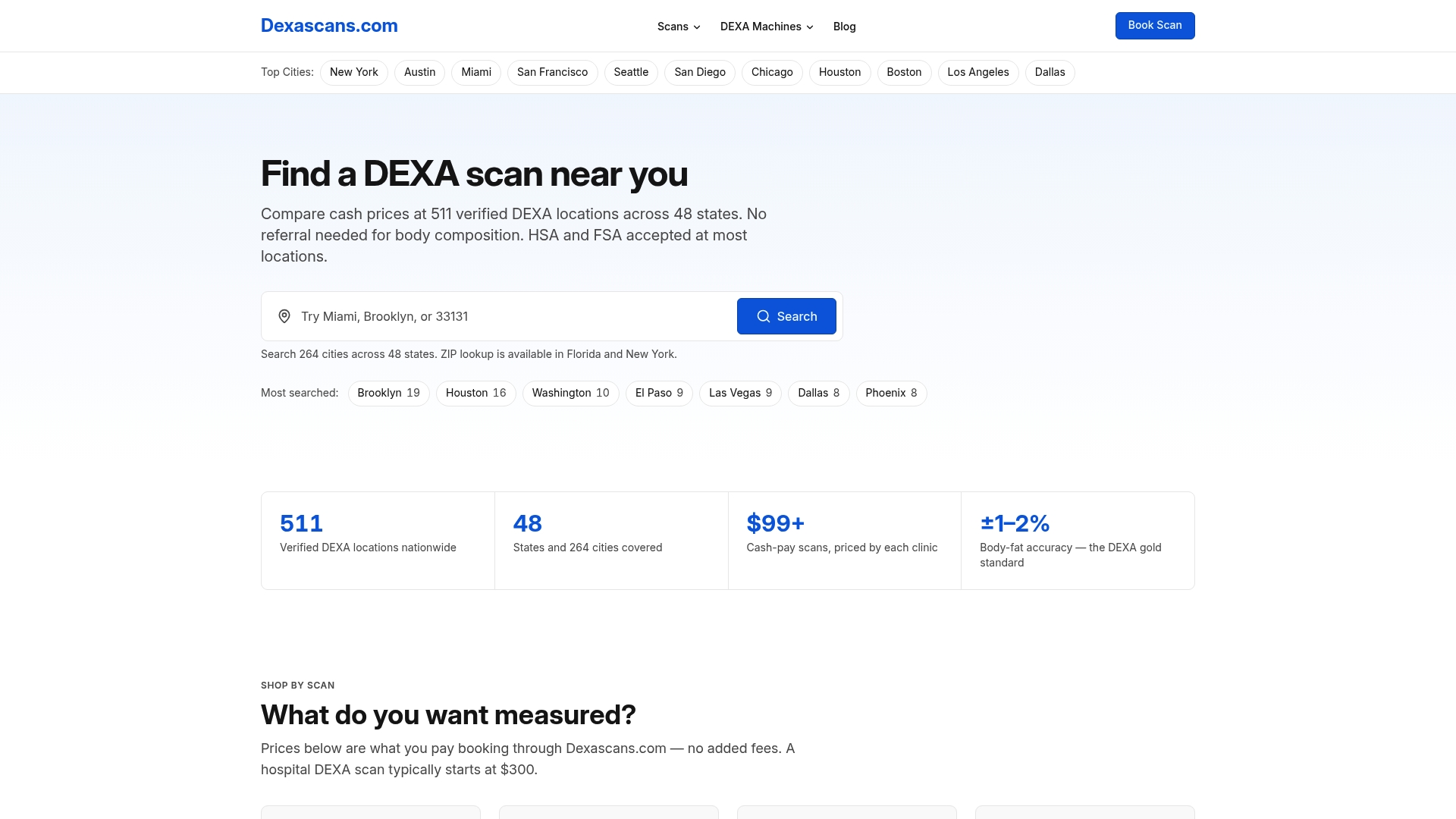
Dexascans.com lists over 511 verified locations across 48 states. Enter your ZIP code, compare cash prices, check which scans each clinic offers, and book directly with the clinic. You do not pay us, and you do not need a physician referral to book through the platform. Start with our bone density test page or the body composition scan page, or go straight to the Dexascans.com search.
FAQ
How much does a bone density test cost without insurance?
As of November 16, 2026, Discretionary Health’s dataset shows a national average cash price of $228.29 for clinical bone density scans. Individual clinics price well above and below that, so compare by ZIP code before booking.
Can I get a private DEXA scan without a doctor’s referral?
Yes for body composition scans at most clinics. For diagnostic bone density scans, the clinic’s own process handles any needed order. Through Dexascans.com you book directly with the clinic.
Do you leave your clothes on for a DEXA scan?
Usually yes. Wear comfortable clothing with no metal, such as zippers, snaps or underwire, or change into a gown if the clinic provides one.
What can throw off a DEXA scan?
Recent contrast or nuclear medicine studies, calcium supplements taken shortly before a bone scan, large changes in hydration, hard exercise right before a body composition scan, and metal implants near the scanned area can all affect results. Using the same machine each time also keeps your results comparable.
Sources
- Discretionary Health: Diagnostic Test Prices for DEXA
- USPSTF: Osteoporosis to Prevent Fractures, Screening (2025)
- CMS Medicare Benefit Policy Manual, bone mass measurements
- AAP: Bone Densitometry in Children and Adolescents
- Use of dual energy X-ray absorptiometry in pediatric patients (PMC)
- Boise State Human Performance Lab: Body Composition Tests
Recommended
Medical Disclaimer: The information provided on this website is for general informational purposes only and is not intended as a substitute for professional medical advice, diagnosis, or treatment. Always seek the advice of your physician or other qualified health provider with any questions you may have regarding a medical condition. DEXA scan results should be interpreted by a qualified healthcare professional.