DEXA Scan Locations: How to Find the Right One Near You
Find DEXA scan locations by city or ZIP, learn which scan type you need, what it costs, and what to check before you book a body composition or bone density scan.
The fastest way to find a DEXA scan near you is to search by city or ZIP code on a directory built for it, then compare scan types and cash prices before you book. Dexascans lists more than 511 verified locations in 48 states, where you can book body composition and bone density scans without a physician referral. The right location is the one that offers the exact scan you need, at a price you can see up front.
TL;DR
- Decide first whether you need a body composition scan (fat, lean mass, visceral fat) or a bone density scan (osteoporosis screening). Many sites offer both, some only one.
- Search by ZIP code and compare cash prices. Published prices range widely by region and facility type, from about $50 to $150 in the examples below.
- Hospital systems often require a provider order. Dexascans lists locations where you can book directly without a referral.
- Insurance, including Medicare, generally covers bone density screening for eligible patients, but body composition scans for fitness are usually self-pay.
- Before you book, confirm scan type, prep rules and how you receive results.
Table of Contents
- Start with the scan you actually need
- How to find DEXA scan locations by ZIP code
- What a DEXA scan costs by location
- Insurance: when a scan is covered and when it is self-pay
- Accuracy: what to expect from a body composition scan
- What to check before you book
- Find a verified location
- Our perspective
- FAQ
- Sources
Start with the scan you actually need
A DEXA (dual-energy X-ray absorptiometry) scan uses very low-dose X-rays to measure what your body is made of. Two different exams share the name, and a location that offers one does not always offer the other.
Bone density scan. This measures bone mineral at the hip and lower spine, where osteoporosis-related fractures commonly occur, according to RadNet’s DEXA service page. It is the exam used to diagnose osteopenia and osteoporosis.
Body composition scan. This measures fat mass, lean tissue mass, visceral fat and bone mineral content for the whole body, per the same RadNet page. UVA Health notes that a whole-body composition scan cannot diagnose osteopenia or osteoporosis, though it may flag a need for further testing. So if your goal is osteoporosis screening, book a bone density scan, not a body composition scan.
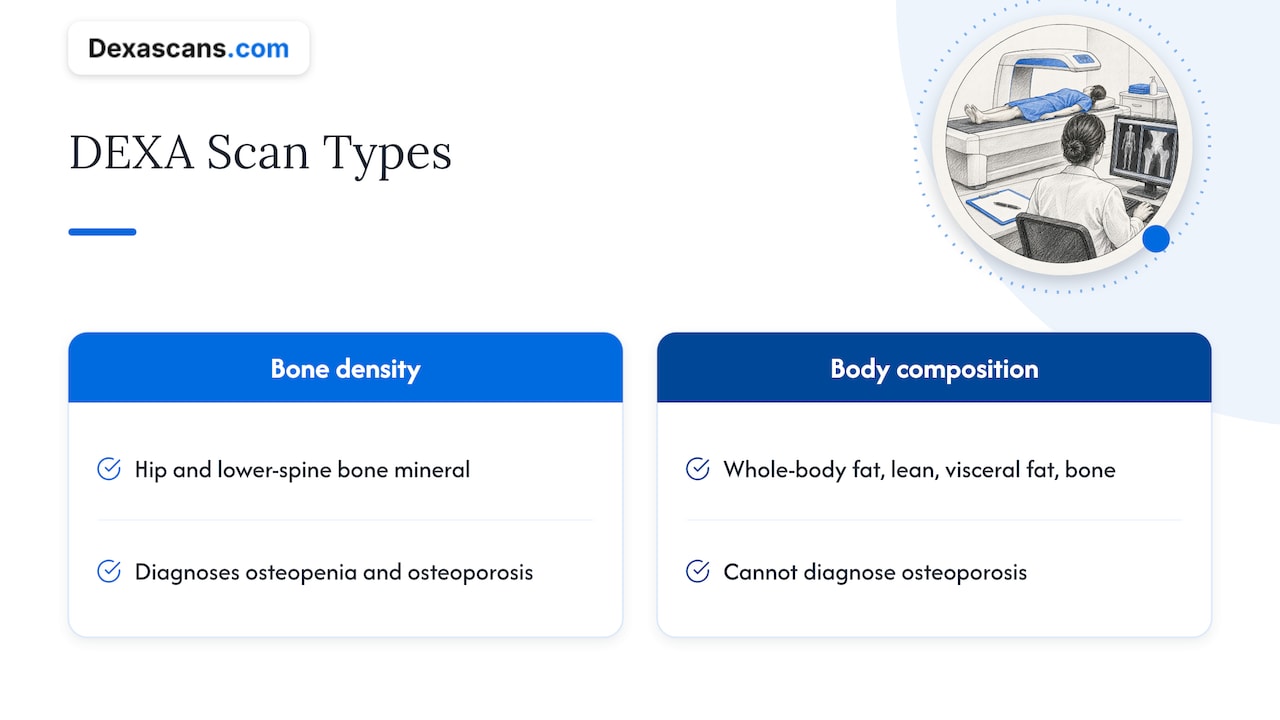
Both are quick, painless and need no anesthesia, according to UVA Health. Some sites perform them separately or together, depending on the equipment on hand.
Our pages on the body composition scan and the bone density test explain each in more detail.
What about a three-site scan?
You may see this phrase on a clinic menu. A standard bone density scan routinely measures two sites, the lumbar spine and the hip. The third site is the forearm (one-third radius), added mainly for patients with hyperparathyroidism or when only one hip can be scanned, according to the ACR Appropriateness Criteria. Your doctor decides whether you need it.
How to find DEXA scan locations by ZIP code
Searching by ZIP code is simple, but the details at each step decide whether you end up at the right place.
- Enter your city or ZIP code. On Dexascans you can search by city or ZIP and see nearby clinics in one list, so you are not piecing together phone calls to imaging centers one at a time.
- Filter by scan type. Listings show whether a clinic offers full-body composition, bone density, combined appointments, or add-ons such as VO2 max and resting metabolic rate (RMR) testing. This matters because the same system can offer different exams at different sites. UVA Health, for instance, performs whole-body composition scans in Charlottesville but bone density scans at three sites, as its service page shows.
- Compare cash prices. Our listings show transparent cash pricing, so you can weigh clinics against each other before you call.
- Widen your radius if needed. Prices and scan types can change a lot across a metro area. A short drive can save real money.
- Book directly with the clinic. No physician referral is needed at the locations we list.
The referral point deserves attention. Many hospital-based locations do require one. Bryan Health states that a provider order is required for its bone density scans, and OHSU says a referral from your doctor is required to schedule. If you want to skip that step, search a directory of direct-booking clinics, as described above.
What a DEXA scan costs by location
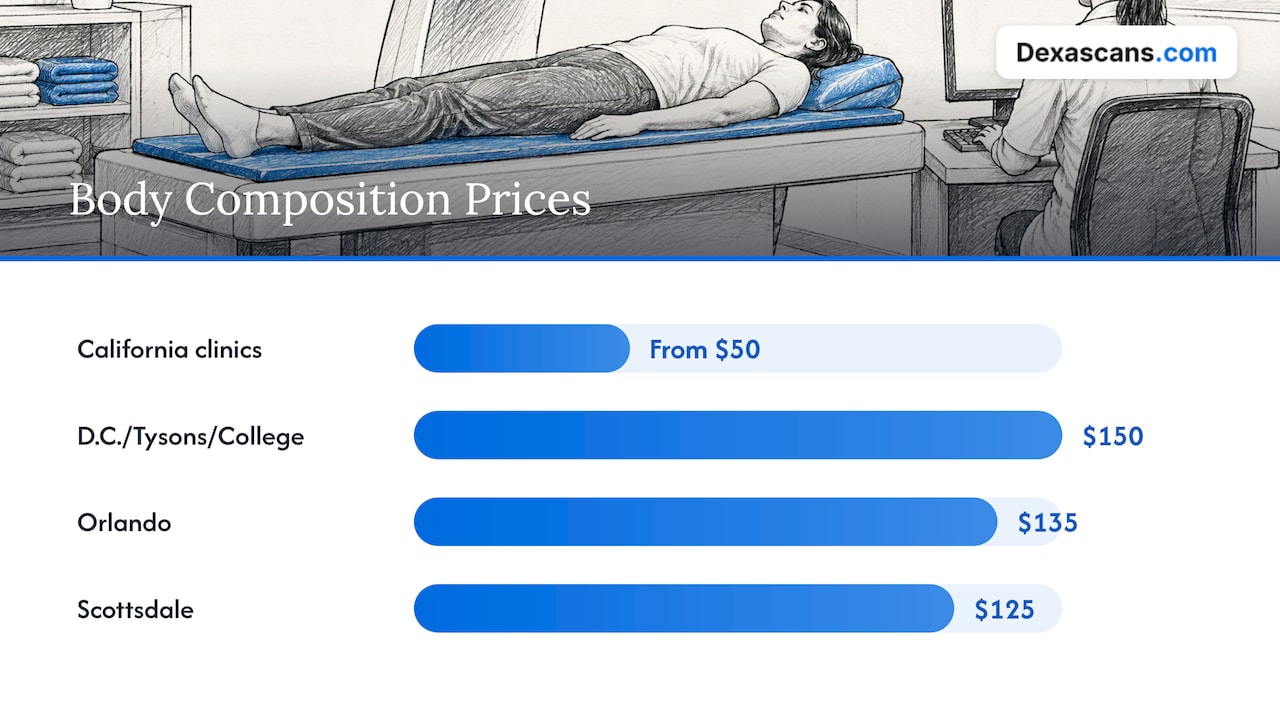
Price depends on the region, the type of facility and what the appointment includes. Examples from providers’ own pricing pages show the spread:
| Location | Scan | Published price |
|---|---|---|
| Rancho Mirage, San Dimas, Temecula, CA | Total body composition | From $50 |
| Same provider | Osteoporosis screening | From $80 |
| Same provider | Combined scan | From $100 |
| Washington DC, Tysons, College Park | Body composition | $150 |
| Orlando | Body composition | $135 |
| Scottsdale | Body composition | $125 |
The California figures come from Desert Dexa’s services page, the others from Composition ID’s scan page. These are the providers’ own listed prices and can change, so check the clinic page for the current figure.
Across the country, cash prices for a body composition scan vary roughly from $40 to $400 depending on facility type and add-ons, as we break down in our guide to body composition scan cost. Hospital billing tends to sit at the high end. Dedicated body composition clinics are often much lower, and that gap is why comparing by ZIP pays off.
Worked example
Say you live in Southern California and want a body composition scan plus a bone density check. Booking a combined scan at a provider listing one from $100 is cheaper than paying for two separate visits at, say, $50 and $80, which would total $130. Always ask whether a combined appointment is available at the location you pick.
Insurance: when a scan is covered and when it is self-pay
Coverage depends on why you are being scanned.
Osteoporosis screening. Medicare Part B covers bone mass measurements once every 24 months (more often if medically necessary) for eligible patients, and you pay nothing if the provider accepts assignment, according to Medicare.gov. Eligibility includes estrogen-deficient women at risk of osteoporosis, people with X-ray evidence of osteoporosis, those on steroid-type drugs, and others listed on that page.
Private insurance. Policies differ. Humana’s medical coverage policy, effective January 2024, covers DXA about once every two years for osteoporosis screening in women 65 and older, or postmenopausal women 64 and younger at increased risk. The same policy lists whole-body DXA for body composition as not covered. OHSU advises patients to confirm coverage for CPT code 77080, the billing code for a DEXA scan.
Body composition for fitness or weight tracking. This is typically paid out of pocket, which is where clear cash pricing helps most. For a deeper walk-through, see our guide on avoiding surprise DEXA bills.
If you are screening for osteoporosis and want your insurer or Medicare to pay, talk with your doctor about whether you qualify and which sites bill your plan.
Accuracy: what to expect from a body composition scan
DEXA is a precise way to track body composition, and consistency is what makes it useful for trends. Our listings describe body fat measurement precision of about ±1-2%.
A few points help you read your results well:
- The ISCD’s 2013 position document sets minimum acceptable technologist precision at 3% for fat mass, 2% for lean mass and 2% for percent fat. Precision varies by device, body size and age.
- The same document says clinics should establish their own precision and least significant change values before stating quantitative change. In practice, that means repeat scans at the same location on the same machine give the cleanest comparison.
- For visceral fat and appendicular lean mass index (ALMI), UVA Health explains that higher visceral fat is associated with greater cardiovascular and metabolic risk, and a low ALMI with greater sarcopenia risk. Sarcopenia is age-related loss of muscle.
For athletes and lifters tracking muscle gain and fat loss, the practical advice is to pick one location and return to it, with similar hydration, food and timing each visit.
What to check before you book
A short list saves a wasted trip.
- Referral. Confirm whether the site requires one. Direct-booking clinics do not.
- Scan type. Make sure it is the exam you want: body composition, bone density or both.
- Prep. One hospital’s guidance, from Windsong Radiology, says to arrive 15 minutes early, skip calcium supplements the morning of the exam, avoid metal in the abdominal or pelvic area and wait 14 days after a barium study. OHSU says to delay the scan if there is any chance of pregnancy or if you had a bone scan, contrast CT or barium test in the past 10 days. Follow the instructions from the clinic you book.
- Results. Ask how and when you receive them. At Windsong, a radiologist reviews the scan and sends results to your physician within 7 business days. Body composition clinics often hand you a report at the visit.
- Add-ons. If you want VO2 max or RMR testing, filter for clinics that list them.
If you have osteoporosis or are building a safe exercise routine around low bone density, this guide to Pilates for osteoporosis covers which movements to favor and which to modify.
Find a verified location
We built Dexascans so you do not have to call a dozen imaging centers to learn who offers what. Search by city or ZIP, compare cash prices, check which scan types each clinic offers and book directly, with no referral. Our directory covers more than 511 verified locations in 48 states. If you are in central Ohio, our Dublin, OH page is one example of a local listing.
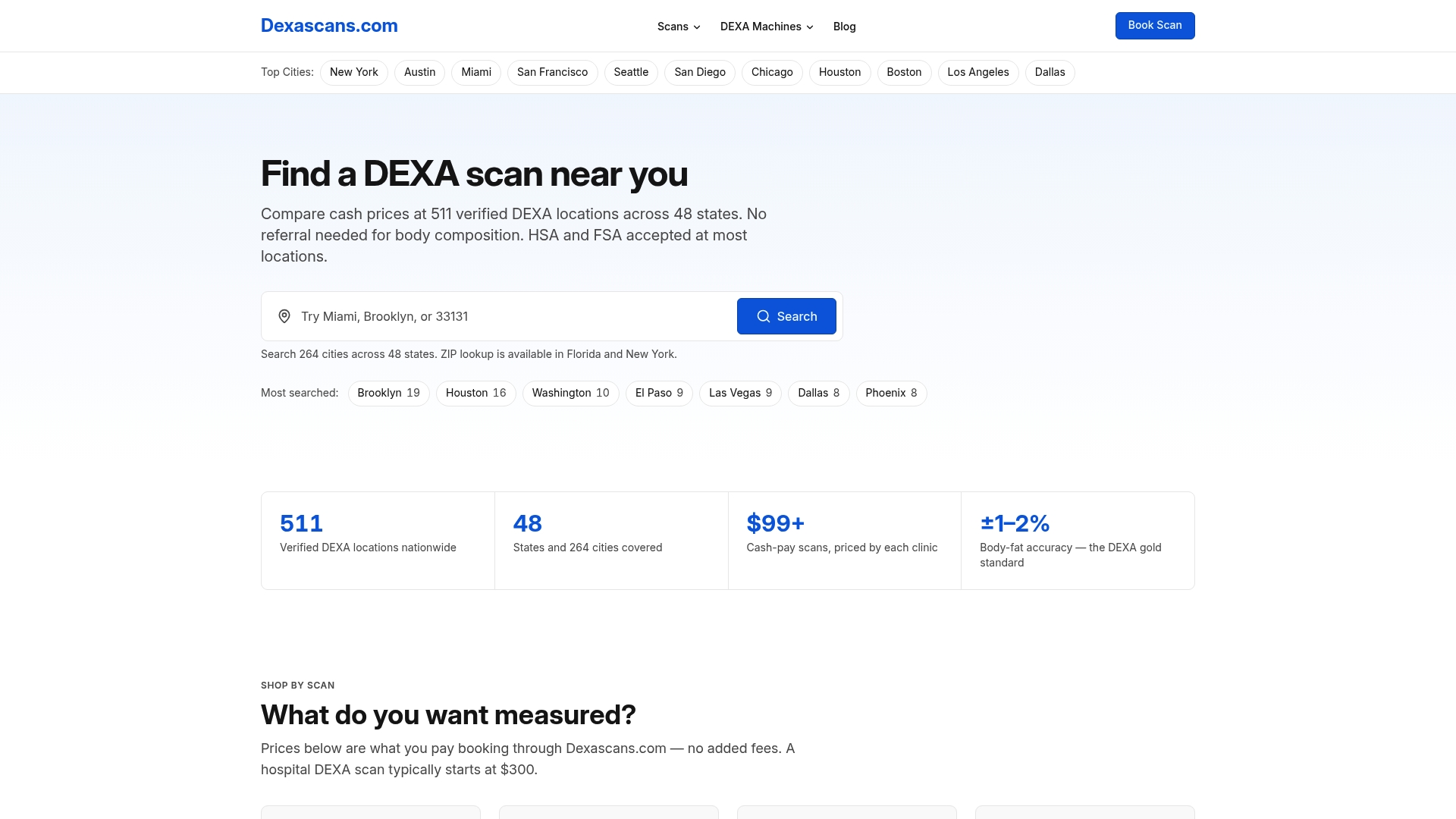
Start on our home page and enter your ZIP code to see nearby clinics.
Our perspective
Most people who search for a DEXA scan are not shopping for a medical procedure. They want a number they can trust and a price they can see. We built Dexascans around that.
The trouble we hear about is the same everywhere: the scan type is unclear, the price is hidden until you call, and a referral requirement appears at the last step. Our approach is to list verified locations, show cash pricing and make the scan types plain, so you choose with the facts in front of you.
Our advice: decide whether you need bone density, body composition or both, pick a location with a price you like, and then keep returning to the same one. Consistency is what turns a scan into a useful trend line.
Erik
FAQ
Do I need a referral for a DEXA scan?
Not at the direct-booking clinics we list. Many hospital systems do require a provider order, as Bryan Health and OHSU state on their pages. If you want to book on your own, search by ZIP and choose a no-referral location.
Will insurance pay for my scan?
Medicare Part B covers bone mass measurements every 24 months for eligible patients, per Medicare.gov. Body composition scans for fitness are usually self-pay. Check your plan’s rules for CPT 77080 and talk with your doctor if you are screening for osteoporosis.
How long does a DEXA scan take?
Both bone density and body composition scans take a few minutes and are painless, according to UVA Health. Plan for a little extra time to check in and review your report.
Can a body composition scan detect osteoporosis?
No. UVA Health explains that whole-body bone density from a composition scan cannot detect osteopenia or osteoporosis. Book a dedicated bone density scan of the hip and spine for screening.
Sources
- DEXA Body Composition & Bone Density Scans, UVA Health
- DEXA Scan, RadNet
- ACR Appropriateness Criteria Osteoporosis and Bone Mineral Density
- Bone Density Scan, Bryan Health
- Bone Density Lab and Patient Information, OHSU
- DEXA Scan Cost & Pricing, Desert Dexa
- Dexa Scan Body Composition Test, Composition ID
- Bone mass measurements, Medicare.gov
- Humana medical coverage policy, DXA
- ISCD DXA Body Composition Position 2013
- Bone Density (DEXA), Windsong Radiology
- Pilates for Osteoporosis
Medical Disclaimer: The information provided on this website is for general informational purposes only and is not intended as a substitute for professional medical advice, diagnosis, or treatment. Always seek the advice of your physician or other qualified health provider with any questions you may have regarding a medical condition. DEXA scan results should be interpreted by a qualified healthcare professional.