Body Composition at the Gym: What It Tells You and How to Get It Right
Learn how gyms measure body composition, what affects the numbers, and when a DEXA scan gives you the precise, repeatable result you need to track progress.

Body composition is the split of your body into fat and everything else: muscle, bone and water. A gym can estimate it in a few minutes with calipers or a handheld or standing scale. If you want a number precise enough to track muscle gain and fat loss over months, a DEXA scan is the standard to aim for, and you can book one directly at a clinic near you without a referral. Below you will find how each gym method works, what moves the result, and how to make every measurement comparable to the last.
TL;DR
- Body composition separates fat from muscle, bone and water. Scale weight and BMI cannot do that.
- Gyms typically use skinfold calipers, bioelectrical impedance (BIA) or, rarely, underwater weighing. Each gives an estimate, and results shift with how you prepare.
- DEXA is widely considered the criterion standard for body composition in sport, and it also reports where fat and lean mass sit in your body.
- Standardize the conditions (fasted, rested, same device, same time of day) so that a change in your number is a change in your body.
- Dexascans lists 511 verified locations in 48 states where you can book a DEXA scan without a physician referral.
Table of Contents
- What body composition means and why weight is not enough
- How gyms measure body composition
- Why the numbers on your gym printout can disagree
- How to prepare so repeat tests are comparable
- Tracking muscle gain and fat loss over time
- When a DEXA scan is the better next step
- Booking a scan without the usual hassle
- Where to start with Dexascans
- Our perspective
- FAQ
- Sources
What body composition means and why weight is not enough
Your body weight is the total mass of everything in you: muscle, bone, fat and water. MedlinePlus explains that BMI, which is calculated from height and weight, does not distinguish between fat, muscle and bone. It may overestimate body fat in athletes and underestimate it in older people who have lost muscle.
That is why two people of the same height and weight can look and feel very different. UC Davis Sports Medicine notes that muscle is denser than fat, so assessing body fat is necessary to understand overall body composition, and that two people with the same height and weight may face different health issues because their composition differs.
A simple example: you start lifting and eating more protein. After twelve weeks the scale shows the same 180 pounds. You might assume nothing happened. A body composition measurement could show that you lost fat and gained lean mass, which is exactly the result you were working toward. If you want to go deeper on the weight and BMI question, our guide on why BMI and DEXA results differ walks through it.
How gyms measure body composition
Most gym assessments fall into three families. The NSCA describes these field methods, and they differ in what they actually measure.
Skinfold calipers
A trainer pinches a fold of skin and fat at set sites and measures its thickness. In the NSCA’s three-site protocol, the sites are chest, abdomen and thigh for men, and triceps, suprailiac (just above the hip bone) and thigh for women. Readings are taken within about two seconds and repeated two to three times, then averaged. The result is plugged into an equation to estimate body fat percentage.
The method is cheap and portable. Its quality depends heavily on the person holding the calipers. A 2021 peer-reviewed review found that skinfold thickness is the measure least affected by day-to-day variability, and that many experts consider the eight-site protocol from ISAK (the International Society for the Advancement of Kinanthropometry, founded in 1986) to be best practice. The same review describes DXA as widely considered the criterion standard for body composition in sport.
Bioelectrical impedance (BIA)
The scale or handheld device you may have seen at a gym sends a small electrical current through the body. The NSCA explains that BIA measures total body water to indirectly determine fat-free mass, and fat is estimated from what remains. It takes seconds and requires no skill from the operator, which is why it is so common on the gym floor. Because it reads water, anything that changes your hydration changes the answer.
Underwater (hydrostatic) weighing
This method uses Archimedes’ principle: you are weighed on land and then submerged, and your body density is calculated from the difference. It is rarely offered at a regular gym because it needs a tank and a trained operator.
Methods at a glance
| Method | What it measures | Where you find it | Main thing that affects the result |
|---|---|---|---|
| Skinfold calipers | Fat thickness at set sites, converted by an equation | Gyms, trainers | Skill of the person measuring, site accuracy |
| BIA scale or handheld | Electrical resistance, which reflects total body water | Most gyms | Hydration, recent meals, exercise |
| Hydrostatic weighing | Whole-body density | University labs, specialty centers | Residual air in the lungs, procedure |
| DEXA scan | Fat, lean mass and bone mineral with low-dose X-rays | Imaging and body composition clinics | Preparation, same machine for repeat scans |
If you want a quick estimate before you decide on anything more precise, a body fat percentage calculator lets you enter your measurements and see a ballpark figure. Treat it as a starting point and not as a replacement for a measured scan.
Why the numbers on your gym printout can disagree
If you have tested at two gyms, or on two days, and got two different percentages, nothing is wrong with you. Each method uses a different principle and a different equation, so each one answers a slightly different question. Calipers estimate from fat under the skin at a few points. BIA estimates from water. DEXA reads the tissues directly by how they absorb two X-ray energies.
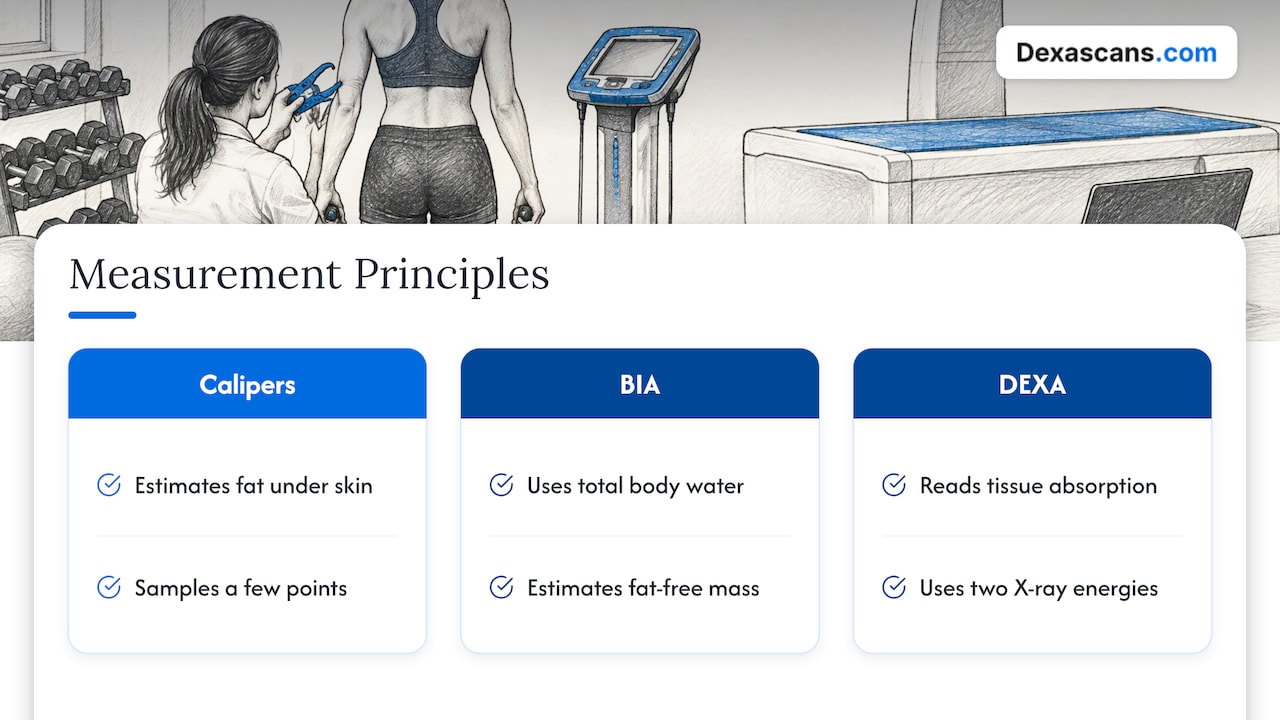
The practical rule: never compare a number from one method with a number from another. Pick one method, use the same device and operator, and compare only against yourself.
How to prepare so repeat tests are comparable
Preparation matters more than most people expect. A 2021 study in the British Journal of Nutrition (Tinsley et al.) found that most body composition methods showed meaningful errors when conditions before the test were not standardized, enough to blunt or exaggerate the change that was measured. DEXA and select digital anthropometry methods were more robust. Overnight fasting and rest were the key standardization steps for tracking changes over time.
Use this routine for every test:
- Test at the same time of day, ideally in the morning.
- Fast overnight and avoid eating or drinking heavily before you go.
- Skip hard training the day before, since a hard session shifts fluid in your muscles.
- Wear similar light clothing with no metal, and use the bathroom first.
- Use the same device and the same operator each time.
- Write down the conditions next to the result so you can explain any surprise.
For a DEXA bone density test specifically, MedlinePlus advises not taking calcium supplements for 24 hours beforehand, removing all metal items, and telling the technologist if you might be pregnant. If you are pregnant or think you could be, tell the clinic before booking. Our page on DEXA scan safety in pregnancy explains the radiation level involved and what to do next.
Tracking muscle gain and fat loss over time
One measurement is a snapshot. The value comes from a series. A 2026 NSCA Strength & Conditioning Journal position paper (Trexler et al.) recommends recurring body composition assessments to monitor short-term changes in fat-free mass and long-term muscular development. Its guidance is to standardize pre-test conditions, use identical equipment, and leave enough time between tests that the change is larger than the machine’s own error.
In practice, that means:
- Do not test every week. Real changes in lean mass are small and slow, so weekly differences are mostly noise.
- Choose a spacing that fits your goal. For body composition, 8 to 12 weeks is a sensible gap. Our guide to how often to repeat a DEXA scan covers the timing for body composition versus bone health.
- Look at the trend, not a single reading. Two or three scans under the same conditions tell you far more than one.
- Pair the scan with your training log. If lean mass is flat while strength is rising, or fat is falling while weight is not, the scan explains what the scale could not.
Athletes and lifters often want more than a single body fat figure. A full scan reports lean mass and fat by region, so you can see whether the arms, legs and trunk are changing as planned. For a deeper look at what a scan can and cannot tell a lifter, read DEXA for bodybuilding.
When a DEXA scan is the better next step
Gym tests are a convenient place to begin. A DEXA scan is where you go when the number needs to be dependable: you are cutting for a goal, managing weight for health reasons, preparing for a competition, or you simply want a baseline you can trust for the next year.
Here is what you get from one visit:
- Body fat percentage with precision of about ±1 to 2%.
- Lean mass and fat mass, in total and by body region.
- A repeatable baseline, because the same clinic and machine can be used for each follow-up.
- Optional add-ons at some locations, such as VO2 max and resting metabolic rate (RMR) testing, so your training and nutrition targets rest on measured data.
Our page on body composition scan cost, accuracy and where to book shows what a standard scan includes. If you want a picture of what you will pay, see DEXA scan cost and prices near you, where cash prices are laid out clinic by clinic.
Body composition scan versus bone density scan
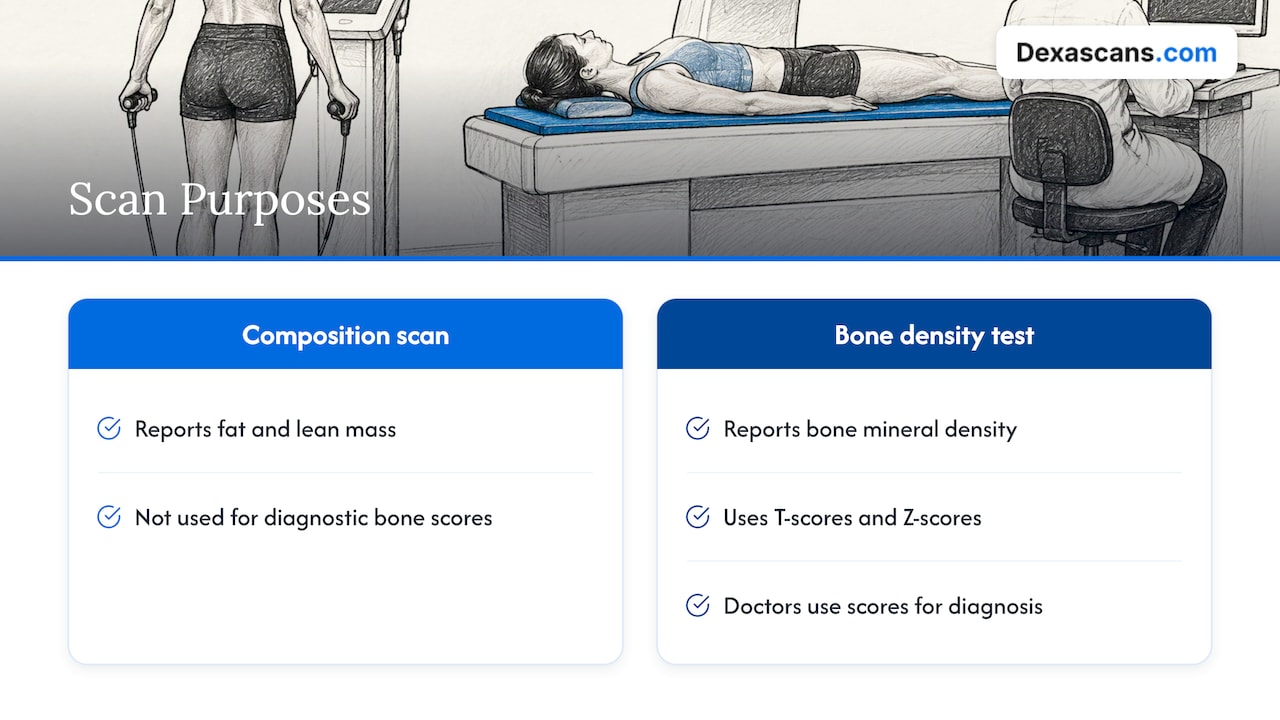
The two are related but not identical. A total-body composition scan reports fat and lean mass. A bone density test reports bone mineral density, scored as T-scores and Z-scores, which are what a doctor uses to diagnose osteopenia or osteoporosis. A body composition scan alone is not used for those diagnostic scores, so if osteoporosis screening is your goal, book a scan that includes bone density, or a combined appointment.
The U.S. Preventive Services Task Force recommendation, summarized by MedlinePlus, is to test women aged 65 and older, and some younger postmenopausal women at increased risk. If you fall in one of those groups, or your doctor has raised a concern about your bones, our bone density test page explains the results and T-scores in plain terms. Talk to your doctor about what your results mean for your own health, especially if you have a fracture history or take medicines that affect bone.
Booking a scan without the usual hassle
You do not need a physician referral to book a body composition scan at the clinics on Dexascans. The steps are short:
- Search by city or ZIP code.
- Compare cash prices and the scan types each clinic offers: full-body composition, bone density, combined appointments, and VO2 max or RMR add-ons.
- Book directly with the clinic.
- Follow the preparation routine above, and arrive fasted and rested.
If you are in the Southeast, for example, you can see local options on our Atlanta, GA page or the Enterprise, AL page.
Where to start with Dexascans
Dexascans is a nationwide directory of DEXA scan clinics: 511 verified locations across 48 states, with cash prices shown up front so you can compare before you call. You choose the clinic, the scan type and the time, and you book directly with them.
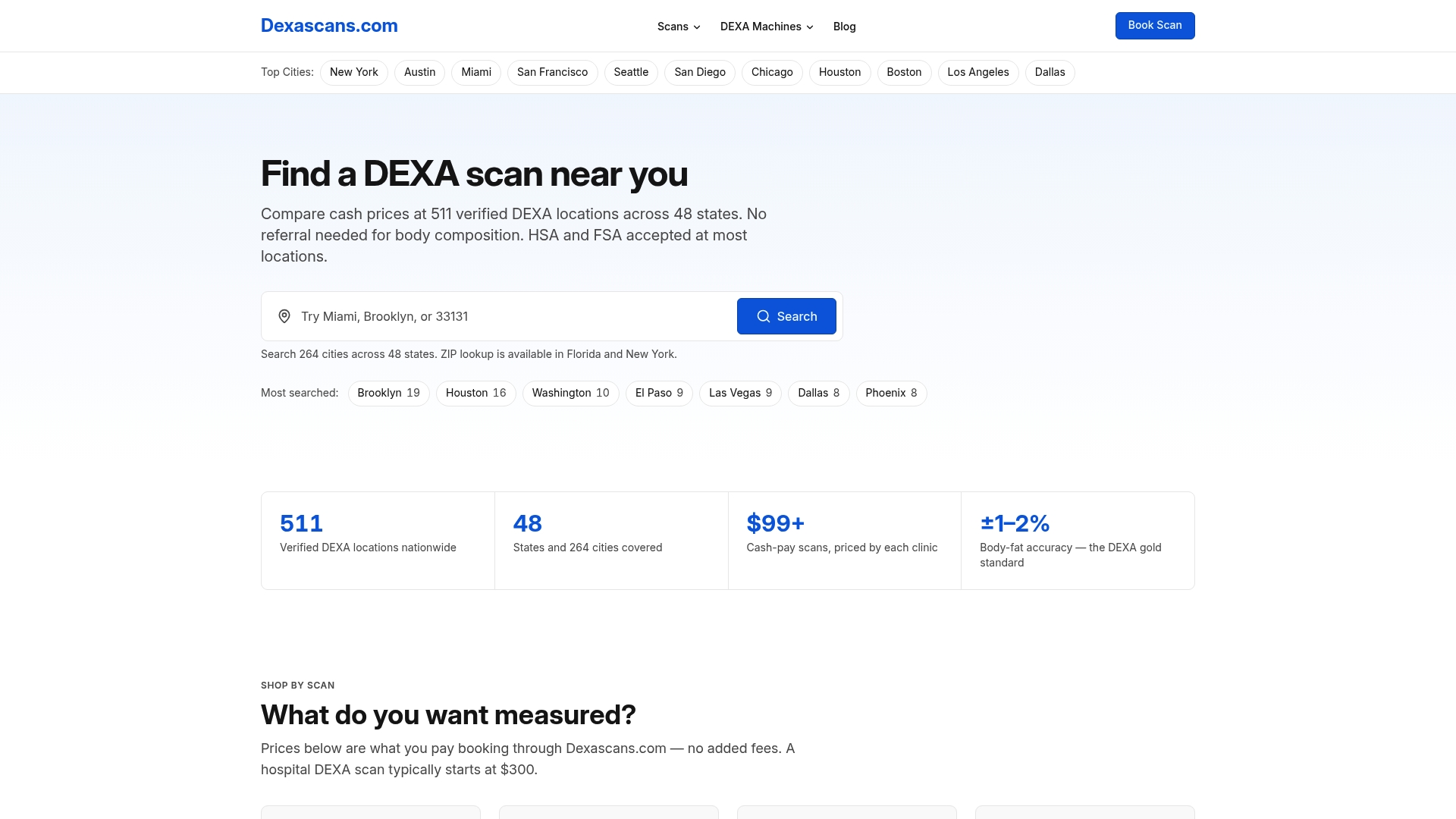
Ready to compare? Start with the body composition scan page or search your city or ZIP from Dexascans.com.
Our perspective
Most people who come to us have already tried the gym’s scale or calipers. They are not wrong to have started there. What they tell us is that the number moved around, and they could not tell whether it was progress or noise.
That is the problem we built Dexascans to solve. A DEXA scan measures body fat with precision of about ±1 to 2%, and when you return to the same clinic under the same conditions, you get a result you can compare. We verify every location we list, and we show cash pricing so you know the cost before you book.
Our advice is simple. Pick one method and stay with it. If your goal needs a number you can trust, whether it is muscle gain, fat loss, athletic preparation or bone health, make a DEXA scan your baseline, then repeat it every 8 to 12 weeks for body composition. No referral, no insurance paperwork, just a clinic near you.
Erik
FAQ
Can my gym tell me my body composition accurately?
Most gyms can give you an estimate using calipers or a BIA device. These give a useful snapshot, and they work best when conditions and operator stay the same each time. For a precise, repeatable number, a DEXA scan is the reference most people use, and you can book one at a clinic without a referral.
How is body composition different from BMI?
BMI uses only height and weight, so it cannot tell muscle from fat. MedlinePlus notes it may overestimate body fat in athletes and underestimate it in older people who have lost muscle. Body composition testing measures the tissues themselves, so it shows what the scale hides.
How often should I measure my body composition?
Every 8 to 12 weeks suits most people tracking muscle gain or fat loss, because changes need time to exceed measurement error. Test under the same conditions each time: fasted, rested, same device. See our DEXA timing guide for the bone health schedule.
Does a body composition scan check for osteoporosis?
A total-body composition scan alone is not used to diagnose osteoporosis. That requires a bone density test with T-scores and Z-scores. Many clinics offer a combined appointment that covers both, so choose that option if bone health is part of your goal.
Do I need a doctor’s referral for a DEXA scan?
Not at the clinics listed on Dexascans. You can search by city or ZIP, compare cash prices and book directly. If you have a medical condition or are pregnant, talk to your doctor before you book.
Sources
- Body Weight | MedlinePlus
- Body Composition | UC Davis Sports Medicine
- 3 Field Methods for Assessing Body Composition | NSCA
- Come Back Skinfolds, All Is Forgiven: A Narrative Review
- Tracking changes in body composition: comparison of methods and influence of pre-assessment standardisation | British Journal of Nutrition
- Fat-Free Mass Accretion: Limits, Targets, and Best Practices | NSCA Strength & Conditioning Journal
- Bone mineral density test | MedlinePlus Medical Encyclopedia
- Body Fat Percentage Calculator
Recommended
Medical Disclaimer: The information provided on this website is for general informational purposes only and is not intended as a substitute for professional medical advice, diagnosis, or treatment. Always seek the advice of your physician or other qualified health provider with any questions you may have regarding a medical condition. DEXA scan results should be interpreted by a qualified healthcare professional.